
The handheld vibration meter features USB and Bluetooth data output for easy real-time monitoring and data recording. The measurement frequency is 10Hz-1kHz, and the AC signal output facilitates auscultation and on-site vibration monitoring. The vibration measurement instrument is used for monitoring equipment in industries such as power, manufacturing, transportation, and petrochemicals.
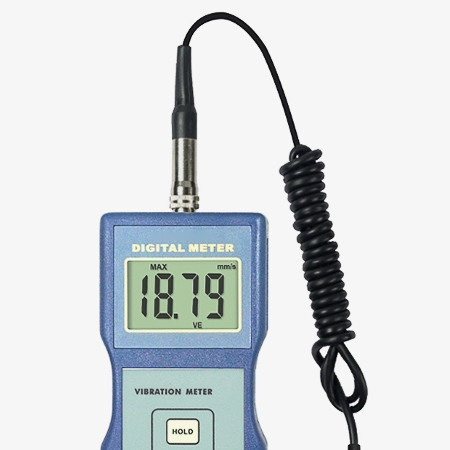
High-definition display screen, AC signal output
- The handheld vibration meter's display screen presents the core measurement parameters in real time, including inductance, capacitance, and resistance values, as well as extended characteristics such as impedance, phase angle, Q value, and D value, allowing users to intuitively judge the current measurement conditions and results.
- The vibration measurement instrument conforms to the ISO 2954 standard, ensuring measurement accuracy and reliability.
- High-performance accelerometer, ensuring accurate vibration measurement and data reproducibility.
- AC signal output facilitates the portable vibration meter's diagnostic capabilities and on-site vibration monitoring.
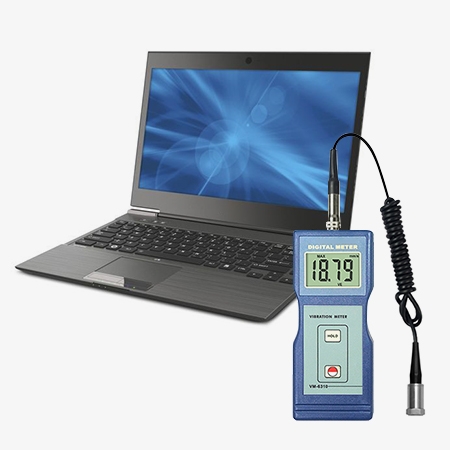
PC connectivity, precise detection
- Equipped with USB and Bluetooth data output functions, the digital vibration meter supports connection to a PC for convenient data storage and remote transmission.
- Compact and durable design, the vibration analysis meter adapts to various working environments and is simple and intuitive to operate.
- Accurately detects and analyzes equipment vibration, enabling timely identification of imbalances, deviations, and other problems.
- The vibration check meter provides real-time data on equipment operating status, aiding in preventative maintenance and fault diagnosis.
Application
This vibration meter is widely used in industries such as power, construction, manufacturing, transportation, and petrochemicals. It is suitable for vibration detection and maintenance of mechanical equipment such as electric motors, fans, pumps, compressors, and reducers, helping users improve the reliability and safety of equipment operation. The vibration check meter can display vibration values in real time and, through its maximum and minimum value recording functions, assists in analyzing vibration data to predict equipment failures or perform preventative maintenance.

Industrial Manufacture

Automobile

Construction

Aerospace
| Model | SISCO-VIBRO-VM-6310 | |
| Sensor | Piezoelectric vibration sensor | |
| Measurement Range | Acceleration | x |
| Velocity | True RMS value of 0.01~199.9 mm/s | |
| Displacement | x | |
| Frequency Range | Acceleration | x |
| Velocity | 10Hz~1kHz | |
| Displacement | x | |
| Accuracy | ± (5%n+2) characters | |
| Working Environment | Temperature | 0~50°C |
| Humidity | < 90%RH | |
| Power Supply | 4 AA batteries | |
| Dimensions | 160 x 68 x 32mm | |
| Weight | 181g (batteries not included) | |
| Standard Configuration | Main Unit | |
| Piezoelectric Vibration Sensor | ||
| Magnetic Holder | ||
| Probe (Spherical/Conical) | ||
| Portable Case (B04) | ||
| Instruction Manual | ||
| Optional Accessories | Headphones | |
| USB connection cable and software | ||
| Bluetooth adapter and software | ||
Q1: What is a vibration meter?
A1: A handheld vibration meter is an instrument used to measure the mechanical vibration of an object. It typically measures parameters such as vibration velocity, acceleration, and displacement, displaying the data digitally or graphically. Portable vibration meters are commonly used for the detection and analysis of vibrations in mechanical equipment, engineering structures, and the environment, serving as an important tool for diagnosing equipment operating conditions.
Q2: What are the uses of a vibration meter?
A2: Handheld vibration analyzers are primarily used to monitor and assess the operational health of mechanical equipment. They help engineers detect potential faults such as bearing wear, rotor imbalance, looseness, and misalignment problems, allowing for proactive maintenance. Furthermore, vibration analysis meters can be used in construction projects such as building construction, bridge construction, and subway construction to monitor environmental vibration levels to ensure safety and compliance with regulations.
Q3: What is the function of a vibration meter?
A3: The function of a vibration check meter is to capture vibration signals from equipment or structures and convert these signals into quantifiable data, such as vibration acceleration (g), vibration velocity (mm/s), and vibration displacement (μm). It can display vibration intensity in real time, helping users determine the presence of abnormal vibrations and analyze the frequency components of the vibration for fault diagnosis and operational status assessment.
Tips: How does a vibration meter work?
Vibration meters typically sense vibrations using internal accelerometers (such as piezoelectric accelerometers). When equipment vibrates, the accelerometer generates an electrical signal proportional to the vibration acceleration. The vibration frequency meter's internal circuitry amplifies, filters, and integrates the signal (to obtain velocity or displacement), ultimately displaying the result digitally. Some advanced wireless vibration meters also perform frequency spectrum analysis (FFT) to help users determine the specific source of the vibration and the type of fault.
Thank you for buying industrial test and measurement equipment on SISCO.com, all products sold by SISCO and the partner cover a 12 months warranty, effective from the date of receiving the products.
What is covered?
SISCO is responsible for providing free spare parts, and free technical support to assist the customer to repair the defective products until the problem is solved.
What is not covered?
- Product purchased from anyone other than a SISCO store or a SISCO authorized reseller.
- Expendable parts.
- Routine cleaning or normal cosmetic and mechanical wear.
- Damage from misuse, abuse or neglect.
- Damage from use of parts other than SISCO approved.
- Damage from use outside the product’s usage or storage parameters.
- Damage from use of parts not sold by SISCO.
- Damage from modification or incorporation into other products.
- Damage from repair or replacement of warranted parts by a service provider other than a SISCO authorized service provider.
- Damage caused by the application environment not meeting the product usage requirements and the failure to perform preventive maintenance.

Shop on sisco.com for all of your industrial test and measurement equipment & accessories including portable detectors, meters, testers, scales, etc.


