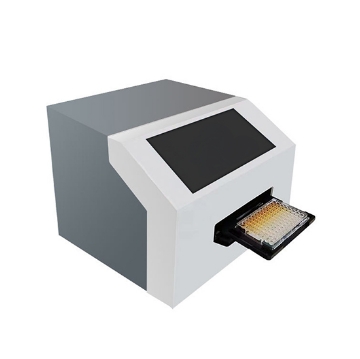
The SISCO absorbance microplate reader is a powerful and user-friendly professional instrument that supports a wide wavelength range from 400 to 800 nm. It offers multiple measurement modes, including single-wavelength, dual-wavelength, and kinetic methods, and can simultaneously process 12 different assays. It also features touchscreen visualization for plate placement and template import, making it an ideal choice for high-throughput, diverse assays in clinical and research laboratories.
SISCO automated microplate reader is a highly integrated, high-performance, high-throughput detection device. Its core strengths lie in its high level of functional integration and professional detection capabilities. Utilizing a high-quality grating monochromator, it covers a wavelength range of 200-1000 nm, enabling fast and accurate full-spectrum scanning. It can complete the detection of a 96-well plate in just 10 seconds, significantly reducing the time required for sample-intensive experiments such as drug screening and cytotoxicity testing, making it an ideal choice for high-throughput detection in laboratories.
The SISCO ELISA microplate reader is a high-precision analytical device specifically designed for clinical enzyme-linked immunosorbent assays (ELISA). Its core features revolve around accurate detection, efficient operation, and flexible adaptability. Equipped with a multi-wavelength optical system, it supports 4-8 configurable filters and utilizes 8-channel simultaneous detection technology, allowing for complete plate detection in under 10 seconds. The device offers various detection and calculation modes, including ABS, Cut-Off, and multiple regression analysis methods, meeting diverse ELISA testing needs.
The SISCO Luminescence Microplate Reader is a high-performance, professionally designed testing device. It employs an industrial-grade 8-inch color touchscreen and an eight-channel vertical optical fiber detection system, ensuring high accuracy (≤ ±0.01 Abs), high stability, and intuitive operation. The instrument supports various detection modes, including endpoint and kinetic methods, and is specifically equipped with an inhibition rate measurement module for food safety applications, enabling professional testing out of the box.
The SISCO multimode microplate reader is a highly efficient and reliable enzyme immunoassay reader. Its core feature is a vertical 8-channel detection system, enabling rapid reading of 96-well plates and significantly improving detection efficiency. The instrument offers flexible wavelength selection (standard 4 wavelengths, expandable to 10 wavelengths), allowing researchers to easily complete the entire workflow from detection to data analysis, making it an ideal choice for routine laboratory applications.
$2,782.94
What is a Microplate Reader?
A microplate reader is a laboratory instrument used to detect and quantify biological or chemical reactions in microplates, typically with 96, 384, or higher density wells. It measures signals such as absorbance (OD), fluorescence, or luminescence and is widely used in enzyme activity assays, cell proliferation studies, and protein or nucleic acid quantification.
How does a Microplate Reader work?
The microplate reader uses a light source at a specific wavelength to illuminate the sample in the wells and measures the transmitted or emitted light with an optical detector. The instrument converts the light signal into quantitative data, reflecting the concentration or activity of the target molecule.
What types of Microplate Readers are available?
Absorbance Readers: Measure light absorption, commonly used in ELISA assays. Fluorescence Readers: Measure fluorescent emission, suitable for protein labeling or DNA/RNA detection. Luminescence Readers: Measure emitted light, used in ATP assays or luciferase reporter assays. Multimode Readers: Combine multiple detection modes for complex experimental needs.
What are the advantages of Microplate Readers?
As a core piece of equipment for enzyme-linked immunosorbent assays (ELISA), the microplate reader boasts significant advantages and a wide range of applications. It supports batch testing of 96-well and 384-well microplates, significantly improving the efficiency of large-scale sample screening and saving considerable time compared to manual operation. Its high-precision optical system and automated control module accurately read absorbance values, reducing human error and ensuring the repeatability and reliability of test results. This device can not only perform ELISA experiments but also be extended to other fields, such as enzyme activity detection and nucleic acid quantification, and is compatible with various reagents and plate types. Furthermore, it features an intelligent operating system that automatically records, analyzes data, and generates reports. When combined with complementary equipment, it can achieve full process automation, reducing the workload of personnel.