
The ELISA reader integrates an advanced optical system, an intelligent operating platform, and comprehensive data management functions, meeting the high standards of modern laboratories for detection efficiency, result accuracy, and standardized procedures.
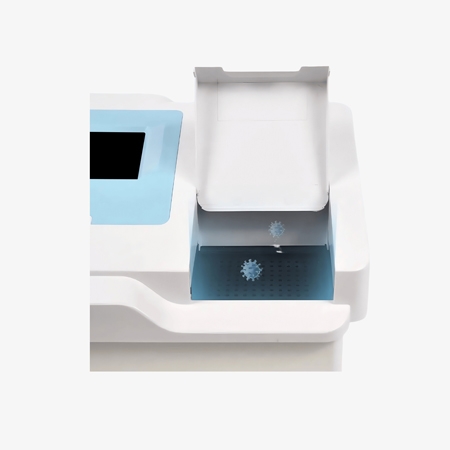
Flexible Wavelengths, 8-Channel High-Speed Detection
- Wavelengths cover common bands such as 405nm and 450nm, with the option to configure up to 4 additional filters. The 8-channel detection speed is ≤10 seconds/plate, adapting to different colorimetric systems while ensuring accuracy and efficiency for high-throughput sample testing.
- Supports four measurement modes: single wavelength, dual wavelength, two-point method, and kinetic analysis, meeting the needs of both high-precision and high-throughput experiments.
- The ELISA plate reader can perform 24 different tests on a 96-well plate and supports custom plate layouts, including multi-project and single-project layouts. Layout templates can be saved and imported, improving experimental efficiency.
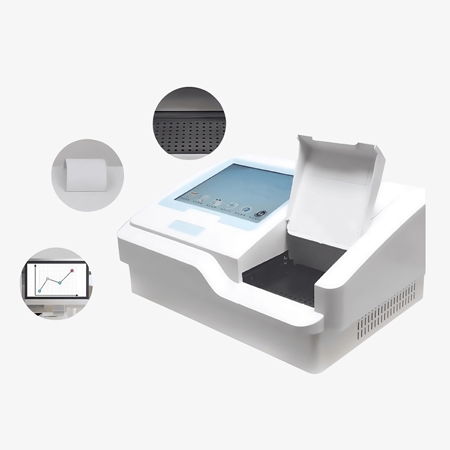
Visual Touchscreen Operation, Adaptable to Diverse Habits
- The instrument integrates a plate shaking function, allowing users to set the shaking speed and time before detection as needed, ensuring thorough mixing of samples and reagents and reducing human error.
- The ELISA plate reader absorbance can store over 500 programmable laboratory test projects and provides data output functionality, supporting the export of text and Excel files for convenient data management and analysis.
- Runs on Windows 7 operating system, equipped with a 10.4-inch color touchscreen, supporting touch and stylus operation, and also allowing for external mouse and keyboard connection.
Applications
Microplate readers are core equipment for quantitative detection in multiple fields. In clinical diagnosis, they detect antigens and antibodies in serum and urine, aiding in the screening of diseases such as hepatitis and tumor markers. In biopharmaceutical research and development, they are used for drug activity evaluation and cytotoxicity detection, supporting new drug development. In food safety testing, they rapidly determine pesticide, veterinary drug residues, and microbial toxins. In animal and plant quarantine, they detect pathogens and antibodies in body fluids to prevent the spread of diseases.
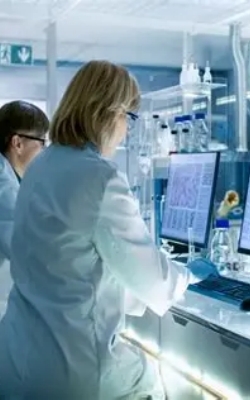
Biomedical Research

Food Safety Monitoring

Animal Quarantine
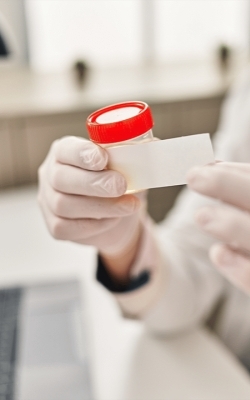
Clinical Diagnosis
| Model | SISCO-AMR-YTSY96S |
| Power Supply | AC 100V~240V, 50/60 Hz |
| Working Environment | Environment temperature: +5℃+40 |
| Relative humidity: 15%一80% | |
| Atmosphererange: 70kPa~ 106kPa | |
| Power supply: AC 100V~240V,50/60 Hz | |
| Transient over-voltage is classified as device class (over-voltage) class-Ⅱ | |
| The pollution level is classified as class I | |
| Storage Temperature | -10℃~+55℃ |
| Light Source | Quartz halogen lamp OSRAM64607,8V/50W |
| Wavelength | 405nm, 450nm, 492nm, 630nm, add at most 4 filters with wavelength between 400nm and 850 nm. |
| Measuring Range | 0.000~4.000A |
| Reading Speed | Single Wavelength ≤3s, Double Wavelength≤6s |
| Warm-up Time | 10 minutes |
| Computer System | X86 core CPU, win7 operating system |
| Programming Items | More than 500 |
| Communication Interface | DVI, VGA, NETWORK INTERFACE, USB, AUDIO INTERFACE, RS-232 |
| Display | 10.4-inch color LED display, resolution 1024*600 |
| Input Mode | Touch screen |
| Memory Capability | Twenty million test data |
| Weight | 11.5kg |
| Dimension | 470mm×350mm×210mm |
Structural diagram
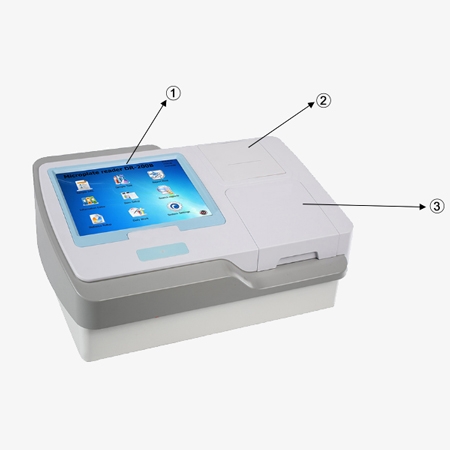
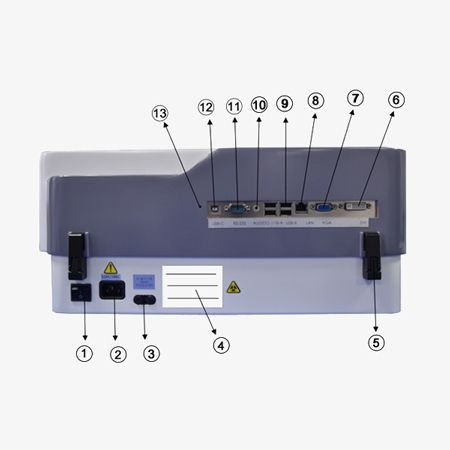
- Power disconnecting switch: Turn on or turn off the power supply.
- Power supply socket: Connect the AC power line.
- Fuses: If no power after turning on the power supply switch, check the fuses.
- Nameplate: Show instrument model, specification, etc.
- Hinges: Connect the bottom shell and top cover.
- DVl interface: digital signal interface . Connect it to the computer to show operation.
- VGA interface: Analog signal interface. Connect it to the computer to show the operation.
- LAN interface: Network interface.
- USB -A/USB-B interface: It is used for connecting a printer, USB flash disk, etc.
- Audio interface: Audio output.
- RS-232 interface: The RS-232 serial port is used for computer software online operation.
- USB-C interface: It is used for computer software online operation.
- Reset: When the instrument XP system appears to have problems, restart the system.

Q1: What is the difference between absorbance, fluorescence, and luminescence microplate readers?
A1: Absorbance, fluorescence, and luminescence microplate readers differ mainly in their detection principles. An absorbance reader measures how much light a sample absorbs and is commonly used for ELISA and OD600. A fluorescence reader uses an excitation light source and detects the emitted fluorescence, offering higher sensitivity for DNA, protein, and cell-based assays. A luminescence reader measures light produced directly by chemical or biological reactions without excitation light, providing the highest sensitivity for assays such as ATP and luciferase.
Q2: What is the wavelength range of a microplate reader?
A2: The wavelength range of a microplate reader depends on the detection mode, but most absorbance readers cover approximately 200–1000 nm for UV-Vis measurements, while fluorescence readers use specific excitation and emission ranges set by filters or a monochromator, and luminescence readers typically do not require wavelength selection because they detect total emitted light.
Q3: How fast can a microplate reader read a full plate?
A3: The reading speed of a microplate reader varies by model and detection mode, but most instruments can read a full 96-well plate in just a few seconds for absorbance, typically 5–10 seconds for fluorescence, and slightly longer for luminescence, depending on integration time. High-performance systems can read even faster, especially in endpoint measurements.
Tips: How to choose the right Microplate Reader?
Key factors to consider:
- Detection modes (absorbance, fluorescence, luminescence, multimode).
- Microplate type and well density (96, 384, 1536).
- Wavelength range and resolution.
- Reading speed and automation level.
- Data analysis software features.
Thank you for buying industrial test and measurement equipment on SISCO.com, all products sold by SISCO and the partner cover a 12 months warranty, effective from the date of receiving the products.
What is covered?
SISCO is responsible for providing free spare parts, and free technical support to assist the customer to repair the defective products until the problem is solved.
What is not covered?
- Product purchased from anyone other than a SISCO store or a SISCO authorized reseller.
- Expendable parts.
- Routine cleaning or normal cosmetic and mechanical wear.
- Damage from misuse, abuse or neglect.
- Damage from use of parts other than SISCO approved.
- Damage from use outside the product’s usage or storage parameters.
- Damage from use of parts not sold by SISCO.
- Damage from modification or incorporation into other products.
- Damage from repair or replacement of warranted parts by a service provider other than a SISCO authorized service provider.
- Damage caused by the application environment not meeting the product usage requirements and the failure to perform preventive maintenance.

Shop on sisco.com for all of your industrial test and measurement equipment & accessories including portable detectors, meters, testers, scales, etc.


