
Displacement Sensors
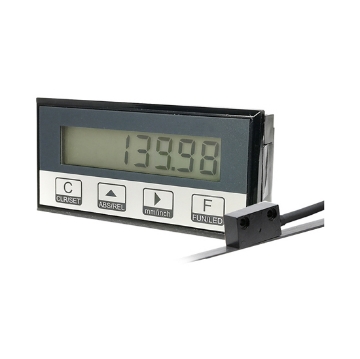
Inductive Displacement Sensor, 1m
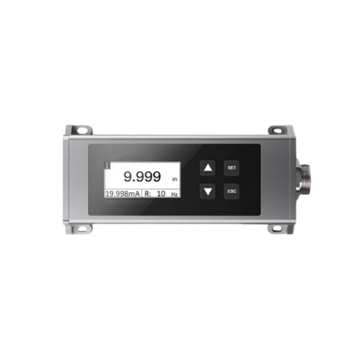
Laser Displacement Sensor, 30m
Linear Displacement Sensor, 1000mm
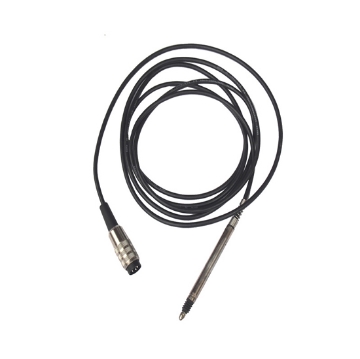
LVDT Displacement Sensor, 10m
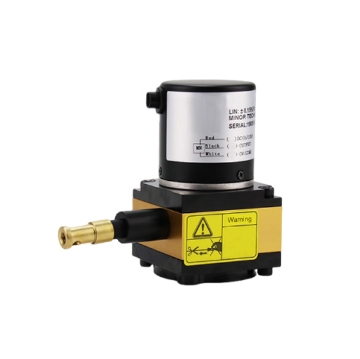
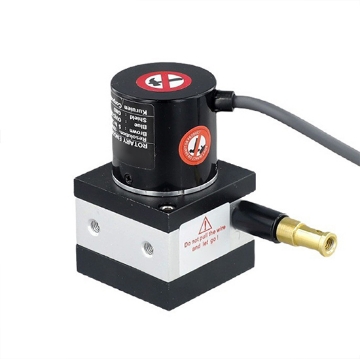
Wire Displacement Sensor, 1000mm
What is a displacement sensor?
A displacement sensor is an electronic or mechanical device used to measure changes in the position of an object. It converts the displacement of an object into an electrical signal for monitoring, control, or recording.
Simply put, it's a device that measures "how much" and "where" an object has moved—for example, how much a door has opened, how far a robotic arm has extended, or the distance a car's brake pedal has been pressed. It can accurately capture these movements and ultimately convert the physical quantity of "displacement" into an electrical signal (voltage, current, resistance, etc.), allowing the device or system to "understand" the object's position change.
What types of displacement sensors are there?
Displacement sensors are mainly divided into two categories: contact and non-contact. The core types are as follows:
Contact: Potentiometer type (inexpensive and simple, but subject to wear), resistance strain gauge type (measures minute displacements, requires calibration);
Non-contact: Inductive type (resistant to harsh environments, measures metals), capacitive type (high precision, measures minute displacements), photoelectric type (fast response, short to medium distance), laser type (extremely high precision, long distance), Hall effect type (compact, shock-resistant, low cost), ultrasonic type (measures non-metals, unaffected by light).
They are widely used in industrial automation (robot positioning), automotive (accelerator/pedal position), aerospace (servo control), and medical equipment, and are key components for achieving precise control and condition monitoring.
What are the core advantages of displacement sensors?
The core advantage can be summarized as the precise and real-time conversion of the key mechanical quantity of "displacement" in the physical world into quantifiable, transmittable, and processable electrical signals, thus becoming the "perception cornerstone" for achieving automated and intelligent control.
Converting Physical Displacement into Measurable Signals
This is the most fundamental advantage. It can accurately convert the invisible and intangible "position changes" and "distances moved" of machines and components into standard electrical signals (such as voltage, current, or digital signals). This makes abstract mechanical motion perceptible, transmittable, and processable.
Achieving Precise Measurement and Control
It provides extremely high accuracy, resolution, and reliability. Whether it's a micron-level change or a large-amplitude linear motion, the sensor can accurately measure it, thus providing accurate feedback to the automation system, achieving high-precision closed-loop control, and ensuring production quality and equipment safety.
As the "Sensory Nerves" of The Automation System
The displacement sensor is the bridge connecting the physical world and the control system. It monitors position information in real time and feeds it back to the controller (such as a PLC), which then makes decisions and drives actuators accordingly. This is the foundation for all automated applications, including smart manufacturing, robotics, and precision machining.
In short, the core advantage of displacement sensors lies in giving machines the ability to "sense their own motion state," which is a prerequisite for achieving precision measurement and intelligent control.

Shop on sisco.com for all of your industrial test and measurement equipment & accessories including portable detectors, meters, testers, scales, etc.


