
Turbidity Meters

Benchtop Digital Water Turbidity Meter, 20 NTU

Benchtop Digital Water Turbidity Meter, 200 NTU

Benchtop Digital Water Turbidity Meter, 400 NTU
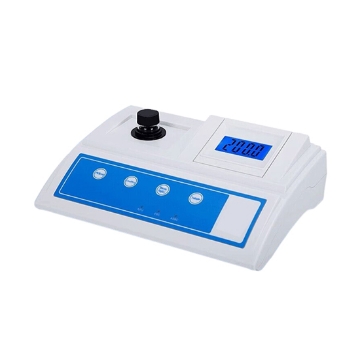
Benchtop Digital Water Turbidity Meter, 50 NTU

Portable Digital Water Turbidity Meter, 1000 NTU

Portable Digital Water Turbidity Meter, 20 NTU

Portable Digital Water Turbidity Meter, 200 NTU

Portable Digital Water Turbidity Meter, 400 NTU

Portable Turbidity Meter for Water, 400 NTU

Portable Digital Water Turbidity Meter, 50 NTU
A Turbidity Meter is a professional water quality testing instrument designed to measure the turbidity level of liquids quickly and accurately. It is widely used in environmental monitoring, drinking water testing, wastewater treatment, aquaculture, laboratories, and industrial process control. By detecting suspended particles in water, the turbidity meter helps users evaluate water clarity and maintain reliable water quality standards.
The SISCO Turbidity Meter sets the standard for reliable and accurate measurement of water turbidity, and have two options for portable and benchtop to meet your usage requirements. Designed for professionals in environmental monitoring, water treatment, and quality control, this state-of-the-art instrument delivers precise results in a wide range of turbidity levels.
Working Principle
The working principle of a turbidity meter revolves around the measurement of the amount of light scattered or absorbed by suspended particles in a liquid sample. Here's a simplified explanation of how it works: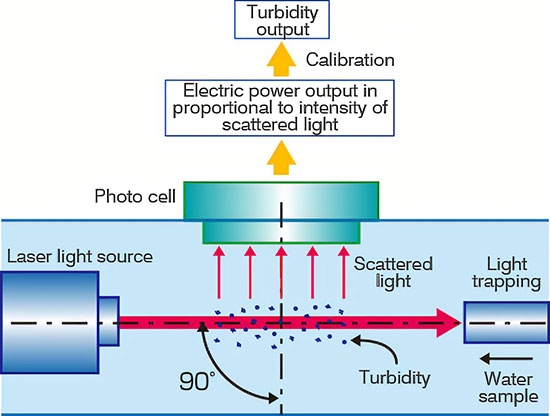
Light Source: The turbidity meter emits a beam of light, usually in the form of white light or infrared light, into the liquid sample.
Scattering and Absorption: As the light passes through the sample, it interacts with suspended particles, colloids, or other impurities present in the liquid. These particles scatter or absorb the light depending on their size, shape, and refractive index.
Detector: The turbidity meter contains a detector positioned at an angle to the light source. The detector measures the intensity of the light that is scattered or transmitted through the sample.
Measurement: Based on the intensity of the scattered or transmitted light detected by the sensor, the turbidity meter calculates the turbidity of the sample. Turbidity is typically expressed in nephelometric turbidity units (NTU) or formazin nephelometric units (FNU).
Calibration: Before use, the turbidity meter is often calibrated using standard reference solutions of known turbidity to ensure accurate measurements.
Display: The turbidity reading is displayed on a screen, providing the user with a real-time indication of the turbidity level of the sample.
Key Features
High Accuracy: The sisco turbidity meter utilizes advanced optical sensors and sophisticated algorithms to deliver highly accurate turbidity measurements, even in challenging conditions.
Wide Measurement Range: From ultra-low turbidity levels like 20 NTU to highly turbid samples like 1000 NTU, the turbidity meter offers a broad measurement range, providing flexibility for diverse applications.
User-Friendly Interface: Designed with simplicity in mind, turbidimeter features an intuitive interface with a large LCD screen, making operation and result interpretation effortless.
Calibration Function: Maintain accuracy over time with ease using our calibration function, ensuring consistent and reliable performance throughout the life of the instrument.
Portable Design: Compact and lightweight, the turbidity meter is built for portability, allowing for easy transport and use in the field or laboratory settings.
Durable Construction: Engineered to withstand harsh environmental conditions, sisico turbidity meter boasts a rugged construction for long-term durability and reliability, even in demanding applications.
Specifications
Measurement Range: 20 NTU to 1000 NTU
Accuracy: ±2% of reading or ±0.01 NTU (whichever is greater)
Resolution: 0.01 or 0.1 NTU
Power Supply: DC or AC adapter (both included)
Weight: 0.4kg
Included Accessories
Benchtop Turbidity Meter
1 x Benchtop Turbidity meter
1 x Power cord
1 x Fuse wire
2 x Sample bottles
2 x 100ml standard solution
1 x Blackout cover
Portable Turbidity Meter
1 x Portable Turbidity meter
1 x Light shield
2 x Sample bottles
1 x 100ml standard solution
1 x 6V power supply
Applications of Turbidity Meters
Turbidity meters are precision instruments used to measure the cloudiness or haziness of a liquid caused by suspended particles. Turbidity is commonly expressed in NTU (Nephelometric Turbidity Units) and is a key indicator of water quality, filtration efficiency, and overall environmental safety.
SISCO turbidity meters are widely used across environmental, industrial, and laboratory applications where accurate water quality monitoring is required.
Environmental Monitoring
Turbidity meters are essential tools for assessing water quality in natural water bodies such as rivers, lakes, reservoirs, and groundwater systems. They help environmental professionals monitor pollution levels, sediment concentration, and ecosystem health.
Water Treatment Plants
In drinking water treatment facilities, turbidity measurement is critical for process control and regulatory compliance. It is used to monitor filtration efficiency, detect contamination risks, and ensure that treated water meets safety standards before distribution.
Beverage and Food Quality Control
In beverage production and food processing industries, turbidity meters are used to ensure product clarity, consistency, and compliance with hygiene and quality regulations. They help manufacturers maintain stable production quality and detect impurities in liquid products.
Research and Laboratory Applications
In scientific research and analytical laboratories, turbidity meters provide accurate measurement of suspended particles in liquid samples. They are widely used in water quality studies, chemical analysis, and environmental experimentation.
Educational and Academic Use
Turbidity meters are commonly used in universities and training institutions for hands-on learning in environmental science, chemistry, and water resource management. They help students understand real-world water quality testing and laboratory measurement techniques.

Shop on sisco.com for all of your industrial test and measurement equipment & accessories including portable detectors, meters, testers, scales, etc.


