
The automated ELISA reader features a 10.4-inch color touchscreen design with an integrated Windows system, offering simple and intuitive operation. All detection can be completed without external devices, significantly improving work efficiency and user experience.
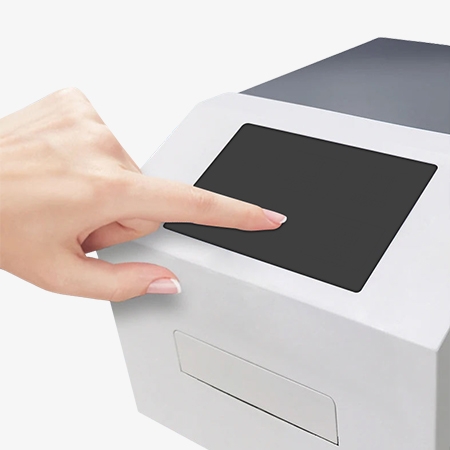
Complete Detection Process on a Single Machine
- Covering a wavelength range of 200~1000 nm, it eliminates the need for filters and is equipped with two silicon photodetectors for precise spectral scanning and measurement, making it particularly suitable for fast, continuous full-spectrum scanning.
- Wavelength accuracy reaches ±0.5 nm, and absorbance accuracy is 1.0%+0.003A in the 0-2.0A range, with stray light ≤0.05% (220 nm), ensuring the reliability and repeatability of detection results and meeting the needs of high-precision spectrophotometric analysis.
- The detection speed is extremely fast, completing the detection of an entire 96-well plate in 10 seconds, significantly reducing the processing time for a single batch of samples and improving data processing time.
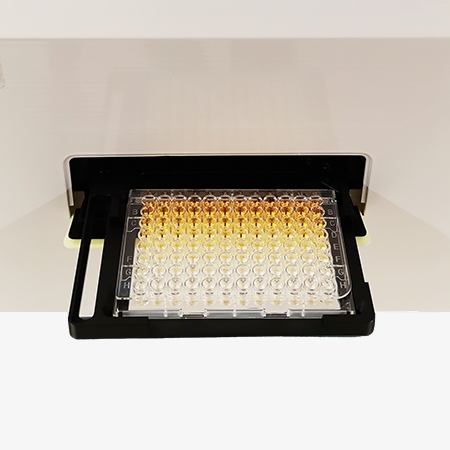
Complete Detection Process on a Single Machine
- Standard features include incubation and shaking modules, with a temperature control range up to 45℃ and three shaking speeds (low, medium, and high), meeting the temperature control needs of different experiments. This reduces sample transfer steps and ensures the stability and consistency of reaction conditions.
- The fully automated ELISA reader supports common detection modes such as spectral scanning, endpoint method, and kinetic method, and also includes more than 11 built-in curve fitting calculation methods (such as linear regression, four-parameter regression, exponential regression, etc.), suitable for different types of experiments.
- Using a 10.4-inch embedded Windows system touchscreen, it integrates a high-performance processor and large-capacity storage, enabling complete detection workstation functionality on a single machine.
Applications
Microplate readers are core equipment for quantitative detection in multiple fields. In clinical diagnosis, they detect antigens and antibodies in serum and urine, aiding in the screening of diseases such as hepatitis and tumor markers. In biopharmaceutical research and development, they are used for drug activity evaluation and cytotoxicity detection, supporting new drug development. In food safety testing, they rapidly determine pesticide, veterinary drug residues, and microbial toxins. In animal and plant quarantine, they detect pathogens and antibodies in body fluids to prevent the spread of diseases.

Biomedical Research

Food Safety Monitoring

Animal Quarantine
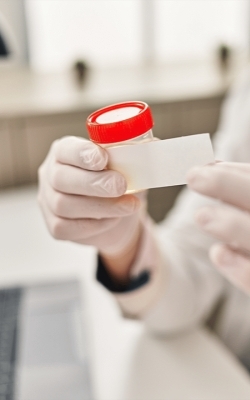
Clinical Diagnosis
| Mdoel | SISCO-AMR-ST1000Q |
| Wavelength Range | 200~1000 nm, 0.5 nm step |
| Reading Range | 0~-4.0 A |
| Spectral Bandwidth | 2±0.4nm |
| Wavelength Accuracy | ±0.5nm |
| Wavelength Repeatability | ≤0.2nm |
| Stray Light | ≤0.05% (220nm) |
| Absorbance Linearity | 2% (0~2.5A) |
| Absorbance Accuracy | 1.0%+0.003A (0-2.0A) 2.0% (2.0-2.5A) |
| Absorbance Repeatability | SD<0.003A or CV<1.0% |
| Incubation Temperature Range and Uniformity | Room temperature +5℃~45°℃, ±0.5°℃ at 37°℃ |
| Detection Speed | 10s (96-well plate) |
| Microplate Compatibility | 96-well standard plate |
| Display Screen | 10.4-inch Windows operating system, touch or mouse, keyboard input/output |
| Workstation | INTEL 12th generation N100 CPU |
| 12G RAM, 256 GB hard drive as standard | |
| External USB 3.0 interface | |
| Microplate reader analysis software with more than 11 curve-fitting calculation methods | |
| Communication Interface | Docking station port, USB port |
| Power Supply | 100~240V, 50/60Hz |
| Dimensions | 65cm×51cm×51cm |
| Weight | 22KG |
Q1: What is the difference between absorbance, fluorescence, and luminescence microplate readers?
A1: Absorbance, fluorescence, and luminescence microplate readers differ mainly in their detection principles. An absorbance reader measures how much light a sample absorbs and is commonly used for ELISA and OD600. A fluorescence reader uses an excitation light source and detects the emitted fluorescence, offering higher sensitivity for DNA, protein, and cell-based assays. A luminescence reader measures light produced directly by chemical or biological reactions without excitation light, providing the highest sensitivity for assays such as ATP and luciferase.
Q2: What is the wavelength range of a microplate reader?
A2: The wavelength range of a microplate reader depends on the detection mode, but most absorbance readers cover approximately 200–1000 nm for UV-Vis measurements, while fluorescence readers use specific excitation and emission ranges set by filters or a monochromator, and luminescence readers typically do not require wavelength selection because they detect total emitted light.
Q3: How fast can a microplate reader read a full plate?
A3: The reading speed of a microplate reader varies by model and detection mode, but most instruments can read a full 96-well plate in just a few seconds for absorbance, typically 5–10 seconds for fluorescence, and slightly longer for luminescence, depending on integration time. High-performance systems can read even faster, especially in endpoint measurements.
Tips: What are some common precautions when using a Microplate Reader?
- Ensure microplates are placed flat and avoid bubbles in wells.
- Avoid samples or containers that may damage optical components.
- Clean optical detectors and sample trays regularly.
- Use the correct wavelength and detection mode for your experiment.
Thank you for buying industrial test and measurement equipment on SISCO.com, all products sold by SISCO and the partner cover a 12 months warranty, effective from the date of receiving the products.
What is covered?
SISCO is responsible for providing free spare parts, and free technical support to assist the customer to repair the defective products until the problem is solved.
What is not covered?
- Product purchased from anyone other than a SISCO store or a SISCO authorized reseller.
- Expendable parts.
- Routine cleaning or normal cosmetic and mechanical wear.
- Damage from misuse, abuse or neglect.
- Damage from use of parts other than SISCO approved.
- Damage from use outside the product’s usage or storage parameters.
- Damage from use of parts not sold by SISCO.
- Damage from modification or incorporation into other products.
- Damage from repair or replacement of warranted parts by a service provider other than a SISCO authorized service provider.
- Damage caused by the application environment not meeting the product usage requirements and the failure to perform preventive maintenance.

Shop on sisco.com for all of your industrial test and measurement equipment & accessories including portable detectors, meters, testers, scales, etc.


