
A split-type surface roughness tester is a measuring instrument designed to evaluate the texture and finish of a surface. This roughness tester is equipped with a built-in printer, allowing test data to be printed directly. Split-type digital roughness tester is often used in machining, mold manufacturing, metalworking, and quality inspection. It provides higher measurement convenience and accuracy.
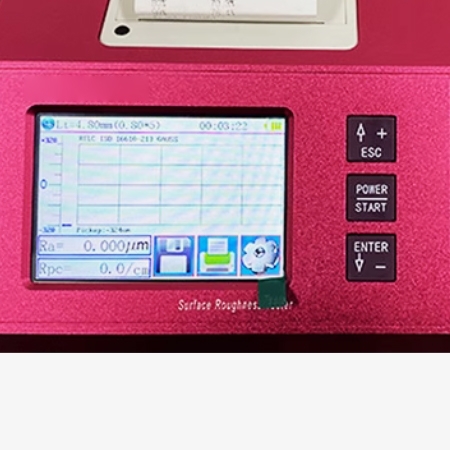
Touch Screen & Simple Buttons
- Ease of Operation. The combination of a touch screen and simple buttons makes the split-type surface roughness tester highly user-friendly. Operators can quickly navigate menus, while buttons provide quick access to essential functions. Also, this reduces the learning curve for new operators
- Faster Measurement Setup. With touch-based input, setting up measurement parameters becomes faster and more efficient.
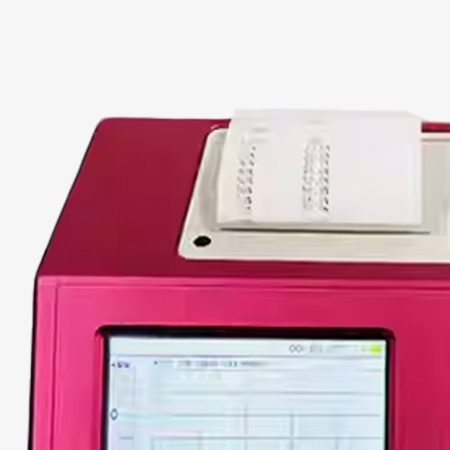
Built-in Printer
- Immediate Documentation. With a built-in printer, the digital surface roughness tester can provide instant printed results of surface roughness measurements. This eliminates the need to manually record data or transfer results to a separate computer system, reducing the risk of human error and ensuring that data is accurately captured in real-time.
- Enhanced Efficiency. Printing results directly on-site significantly speeds up workflow. Operators can complete measurements and immediately produce a report, which is particularly valuable in production environments where time is critical.
- Reduced Data Loss. Direct printing minimizes the risk of losing measurement data due to software crashes, transfer errors, or file corruption.
Applications
SISCO's surface roughness tester is widely used in quality control and research across various industries. It measures surface texture, helping ensure precision and performance in manufacturing. It is commonly applied in metal machining, automotive, aerospace, and mold manufacturing, enabling inspection of shafts, gears and engine parts.

Mold Casting

Automobile Making

Aerospace Industry

Laboratory
| Model | SISCO-SRT-TR280 | ||
| Screen Size | 3.5-inch LCD screen | ||
| Filter | RC, PC-RC, Gauss, D-P | ||
| The Sampling Length(lr) | 0.25, 0.8, 2.5mm | ||
| Assessment Length(ln) | Ln= lr×n n=1~5 | ||
| Measurement Range | The Z-axis(Vertical) | 640μm (-320μm~320μm) | |
| The X-axis(Horizontal) | 17.5mm/ 0.69 inch | ||
| Resolution | The Z-axis(Vertical) | 0.004μm/±40μm | 0.008μm/±80μm |
| 0.016μm/±160μm | 0.030μm/±320μm | ||
| Measurement Item | Evaluation Parameter | Ra Rz Rq Rt Rc Rp Rv R3z R3y Rz(JIS) Ry Rs Rsk Rku Rmax Rsm Rmr RPc Rk Rpk Rvk Mr1 Mr2 | |
| Graphic | Primary profile, roughness profile, load curves | ||
| Sensor | Principle | The displacement differential inductance | |
| Stylus Tip | Natural Diamond, 90°cone angle, 5μm tip radius | ||
| Measuring Force | 4mN | ||
| Skid Force | Less than 400mN | ||
| Measuring Speed | lr=0.25, Vt=0.135mm/s | ||
| lr=0.8, Vt=0. 5mm/s | |||
| lr=2. 5, Vt=1mm/s | |||
| Return Vt=1mm/s | |||
| Accuracy | ±(5nm+0.1A) A: Ra of calibration test block | ||
| Repeatability | No more than 3% | ||
| Residual Profile | No more than 0.010μm | ||
| Power Supply | Built-in 7.4V Lithium-ion battery, Charger: DC9V, 1000mA | ||
| Main Unit Dimension | 155*145*65mm | ||
| Drive Dimension | 23*27*115mm | ||
| Gross Weight | About 4.5kg | ||
| Working Environment | Temperature: -20℃ ~ 40℃; humidity: < 90% RH | ||
| Store Environment | Temperature: - 40℃ ~ 60℃; humidity: < 90% RH | ||
Q1: What is a surface roughness tester?
A1: A surface roughness tester is an instrument used to measure the surface roughness of an object. It can accurately reflect the degree of unevenness of the surface of an object. Surface roughness testers are widely used in manufacturing, engineering, and quality control to ensure parts meet specifications, improve friction performance, and enhance coatings or finishes.
Q2: How do environmental conditions affect roughness measurement?
A2: Environmental conditions can significantly influence roughness measurements. Temperature fluctuations may cause material expansion or contraction, altering surface profiles. Humidity can affect both the material surface, especially porous or hygroscopic materials, and the measurement probe, potentially leading to inaccurate readings. Vibrations or air currents can disturb sensitive instruments, introducing noise or measurement errors. Dust, oil, or moisture on the surface may also interfere with probe contact or optical detection. To ensure reliable results, measurements should be conducted in a controlled environment with stable temperature, low humidity, minimal vibration, and clean surfaces.
Q3: How should a split-type surface roughness tester be maintained?
A3: A split-type surface roughness tester stays reliable when you treat it like a precision tool. Keep the probe and connector clean and free of dust; wipe them with a soft, lint-free cloth after each use. Store the probe in its protective case to avoid impacts or bending. Avoid using the tester in environments with strong vibration, oil mist, or extreme temperatures.
Tips: How does split-type surface roughness tester work?
When measuring the roughness of part surface, the sensor is placed on the surface of the part and then tracing the surface at constant rate. The sensor acquires the surface roughness by the sharp stylus in pickup. The roughness causes displacement of sensor which results in change of inductive value of induction coils thus generate analogue signal which is in proportion to surface roughness at output end of the phase-sensitive rectifier. This signal enters data collection system after amplification and level conversion. After that, those collected data are processed with digital filtering and parameter calculation by chip, and the measuring result can be read on the LCD or printed through built-in printer.
Thank you for buying industrial test and measurement equipment on SISCO.com, all products sold by SISCO and the partner cover a 12 months warranty, effective from the date of receiving the products.
What is covered?
SISCO is responsible for providing free spare parts, and free technical support to assist the customer to repair the defective products until the problem is solved.
What is not covered?
- Product purchased from anyone other than a SISCO store or a SISCO authorized reseller.
- Expendable parts.
- Routine cleaning or normal cosmetic and mechanical wear.
- Damage from misuse, abuse or neglect.
- Damage from use of parts other than SISCO approved.
- Damage from use outside the product’s usage or storage parameters.
- Damage from use of parts not sold by SISCO.
- Damage from modification or incorporation into other products.
- Damage from repair or replacement of warranted parts by a service provider other than a SISCO authorized service provider.
- Damage caused by the application environment not meeting the product usage requirements and the failure to perform preventive maintenance.

Shop on sisco.com for all of your industrial test and measurement equipment & accessories including portable detectors, meters, testers, scales, etc.


