
With a photometric range of 190-1100 nm and 320-1100 nm, the dual-beam design provides more stable and accurate measurements. The uv visible spectrometer has automatic switching between UV and visible wavelength selection, a high-resolution C-T monochromatic, and a high-definition touchscreen for easy operation.
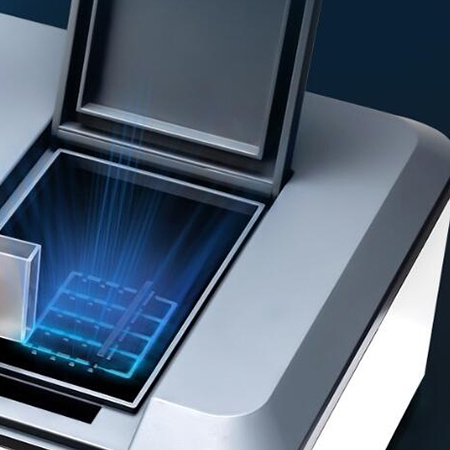
Built-in cuvettes of various sizes, wide measurement range
- The four-slot universal adjustable sample holder (10-50mm) accommodates cuvettes of various sizes.
- The uv visible spectrophotometers calculate the concentration of specific components in a sample by measuring its absorbance. They are primarily used to measure absorbance in the ultraviolet (UV) and visible (VIS) wavelengths, allowing for quantitative or qualitative analysis based on the relationship between absorbance and concentration.
- Double beam uv vis spectrophotometer can be used to determine the concentration of bio macromolecules, particularly proteins, DNA, and RNA.
- The UV and visible light modes feature automatic wavelength switching (auto-calibration).
- The deuterium lamp in the visible spectrophotometer is primarily used for measurements in the UV region, while the tungsten lamp is used for measurements in the visible region. The uv vis spectrometer features a durable aluminum alloy base and reflector mount.
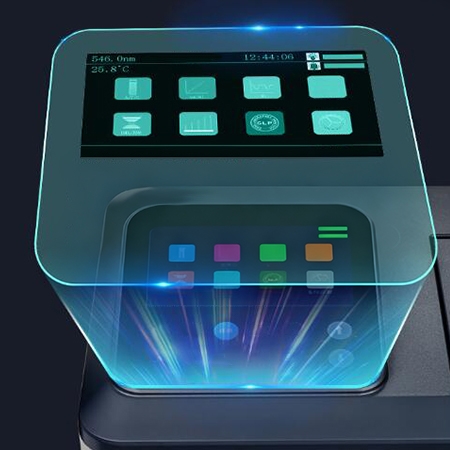
High-definition touch screen, PC software connection
- The 7-inch LCD high-definition screen, with a navigation menu interface, prevents operational errors.
- The uv spectrometer can be connected to a PC and includes an optional PC control software package, including quantitative measurement, qualitative measurement, time measurement, DNA protein measurement, multi-wavelength measurement, 3D graphics analysis, and spectral overlay analysis.
- The double beam spectrophotometer's measurement modes include transmission, reflectance, absorbance, concentration, and energy, allowing for convenient measurement customization.
- Equipped with a high-resolution C-T monochromatic, the double beam uv vis spectrophotometer offers excellent stability and high measurement accuracy.
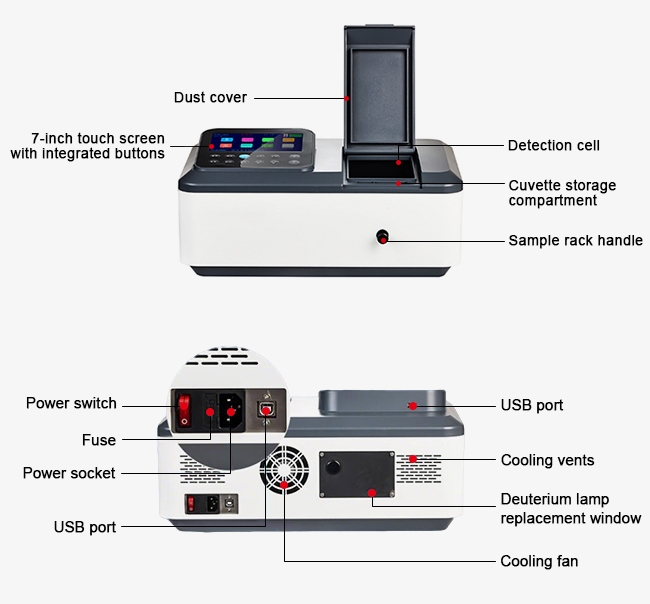
UV Spectrophotometer Structure
Application
A double-beam UV-visible spectrophotometer is an analytical instrument widely used in chemistry, life sciences, environmental monitoring, food analysis, and other fields. By simultaneously measuring the absorbance of a sample and a reference solution, it has important applications in pharmaceutical analysis, nucleic acid and protein detection, environmental pollution monitoring, and optical materials research. It can accurately determine substance concentrations, study reaction processes, and perform quality control.

Food Analysis

Water Monitoring
Chemical Research

Chemistry Testing
| Model | SISCO-UVDB-MDS-V8 | SISCO-UVDB-MDS-U8 | ||
| Optical System | Self-aligning, 1200 lines/mm holographic grating | |||
| Wavelength Range (nm) | 320-1100 | 190-1100 | ||
| Spectral Bandwidth (nm) | 2 | |||
| Wavelength Accuracy (nm) | ±1 | |||
| Wavelength Repeatability (nm) | ≤0.5 | |||
| Transmittance Accuracy (%T) | ±0.5 | |||
| Transmittance Repeatability (%T) | ≤0.1 | |||
| Stray Light (%T) | ≤0.1 @360nm | ≤0.1 @220, 360nm | ||
| Photometric Range | 0-200%T, -0.301-3A, 0-9999c (0-9999f ) | |||
| Light Source | Tungsten lamps | Deuterium lamps and tungsten lamps | ||
| Data Display | 128x64 graphic LCD display | |||
| OS Language | Automatic switching between Chinese and English | |||
| Data Output | USB | |||
| Input Voltage and Frequency | 90-250V/AC 50-60HZ | |||
| Data Output | USB flash drive, Bluetooth, USB software upload | |||
| Data Output Format | CSV | |||
| Host Functions | Basic + Quantitative + Qualitative + Time + DNA + Multi-Wavelength (VC3 does not include DNA measurement) | |||
| Printer | Optional, supports Bluetooth printing | |||
| Dimensions | 450X390X210 mm | |||
| Weight (kg) | 11kg | 12kg | ||
 UV Spectrophotometer Double Beam User Manual.pdf
Q1: What is a double-beam UV-visible spectrophotometer?
A1: A double-beam UV-visible spectrophotometer is an instrument commonly used in chemical analysis, primarily for measuring the absorbance of a sample in the ultraviolet and visible regions.
Q2: How does a double-beam UV-visible spectrophotometer work?
A2: A UV-visible spectrophotometer uses a light source to emit continuous ultraviolet or visible light, which is then split into beams of different wavelengths by a monochromator. These split beams are then split into two paths: one that passes through the sample, and the other that passes through a reference solution or air, serving as a reference. After passing through the sample, the sample beam is partially absorbed by molecules within the sample, and the remaining light is measured by a detector. The reference beam, however, does not pass through the sample and directly measures the intensity of the light source. By comparing the intensity difference between the two beams, the sample's absorbance can be calculated.
Q3: What are the advantages of a double-beam UV-visible spectrophotometer?
A3: It can simultaneously measure the light intensity of the sample and reference solution, comparing them in real time. This effectively eliminates the influence of external factors such as light source fluctuations, temperature changes, and instrument drift, improving measurement accuracy and stability. The instrument provides more consistent results and reduces variation across multiple measurements. Furthermore, double-beam spectrophotometers maintain high measurement reliability and repeatability over extended periods of use.
Tips: What is the difference between single-beam and double-beam UV-Vis spectrophotometers?
- The primary difference between single-beam and double-beam UV-Vis spectrophotometers lies in their optical path design and measurement methods. Single-beam instruments have only one optical path. Light from the light source is split by a monochromator before irradiating the sample. After passing through the sample, the light intensity is measured by a photodetector. Frequent baseline calibration is required during the measurement process.
- Double-beam instruments, on the other hand, split the light source into two beams: one passing through the sample and the other passing through a reference solution or air as a reference. Both beams are measured simultaneously, and the detector receives the intensities of both beams, allowing for real-time comparison of the absorbance difference between the sample and reference.
Thus, double-beam instruments offer higher accuracy and more stable performance than single-beam instruments, making them suitable for applications requiring high-precision quantitative analysis.
Thank you for buying industrial test and measurement equipment on SISCO.com, all products sold by SISCO and the partner cover a 12 months warranty, effective from the date of receiving the products.
What is covered?
SISCO is responsible for providing free spare parts, and free technical support to assist the customer to repair the defective products until the problem is solved.
What is not covered?
- Product purchased from anyone other than a SISCO store or a SISCO authorized reseller.
- Expendable parts.
- Routine cleaning or normal cosmetic and mechanical wear.
- Damage from misuse, abuse or neglect.
- Damage from use of parts other than SISCO approved.
- Damage from use outside the product’s usage or storage parameters.
- Damage from use of parts not sold by SISCO.
- Damage from modification or incorporation into other products.
- Damage from repair or replacement of warranted parts by a service provider other than a SISCO authorized service provider.
- Damage caused by the application environment not meeting the product usage requirements and the failure to perform preventive maintenance.

Shop on sisco.com for all of your industrial test and measurement equipment & accessories including portable detectors, meters, testers, scales, etc.


