
This process calibrator is a highly reliable voltage and current calibrator designed for accurate calibration tasks in various professional settings. Ideal for use in laboratories, industrial environments, and fieldwork, the handheld voltage and current ensures accuracy and stability when calibrating instruments and devices, making it a valuable tool for technicians and engineers.
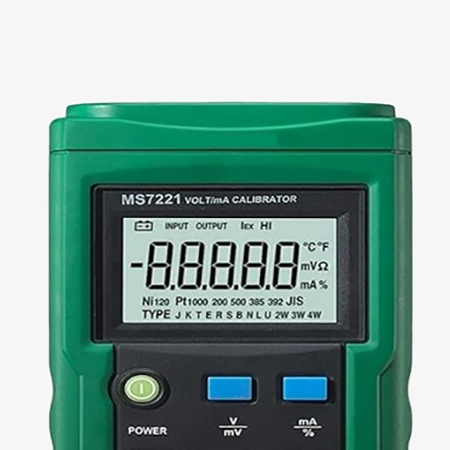
Equipped with High-Contrast Backlit LCD Display
- High-contrast backlit LCD display: The large blue-backlit LCD screen clearly shows output values such as mV, mA, Hz, and percentage signals, ensuring easy reading in both bright and low-light environments.
- Dedicated function keys for quick operation: The device features multiple independent buttons—including INPUT, OUTPUT, V/mV, Hz, and mA—allowing fast switching between measurement and sourcing modes without complex menu navigation.
- Dual-function output and input support: Clearly labeled “INPUT” and “OUTPUT” keys enable seamless transitions between calibrating and measuring different process signals.
- STORE/SETUP key for configuration and data storage: The setup and storage button simplifies device configuration and allows saving key calibration parameters for later use.

Built-In Foldable Stand for Hands-Free Operation
- Built-in foldable stand for hands-free operation: The rear foldable support stand allows the calibrator to sit upright on a workbench, making it convenient for continuous measurements and calibration tasks.
- Durable protective rubber housing: The thick yellow rubberized casing enhances shock resistance and protects the device from accidental drops, ideal for harsh industrial environments.
- Rear mounting slots for secure hanging:Integrated hanging slots on the back enable technicians to mount the device on hooks or panels, keeping both hands free during field calibration work.
- Ergonomic curved back design: The contoured rear shape provides a comfortable grip, reducing hand fatigue during prolonged use.
Dimension

Applications
SISCO process calibrators are widely used in various industries, including manufacturing to ensure the accuracy of sensors in automated systems. Pharmaceuticals: maintaining compliance with strict temperature and pressure regulations. Energy and utilities testing electrical and pressure instruments in power plants and pipelines. Aerospace verifying flight instruments and environmental control systems. Food and beverage to ensure accurate temperature control in processing and storage.
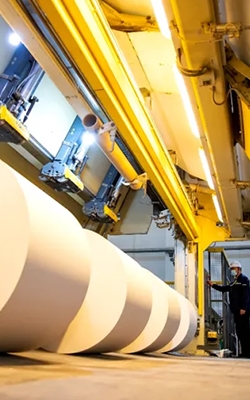 Papermaking
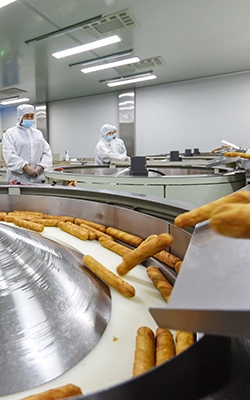 Food
Food
 Light Industry
 Electric Power
| Model | SISCO-PC-MY-926 |
| Storage Temperature | -40°C~60°C |
| Operating Temperature | -10°C~55°C |
| Operating Altitude | 3000 meters maximum |
| Temperature Coefficient | ±0.005% of range per °C for the temperature range-10 °C to 18 °C and 28 ²C to 55°C |
| Relative Humidity | 95% up to 30°C,75% up to 40°C, 45%up to 50°C,35% up to 55°C |
| Shock | Random 2g,5Hz to 500Hz |
| Safety | 1 meter drop test |
| Power Requirements | 9VDC,006P or 1604A |
| Auto Power Off Function | 6min |
| Size | 190mm*89mm*42mm |
| Weight | 350g |

Q1: What is a Process Calibrator?
A1: A process calibrator is a device used to test, calibrate, and troubleshoot process instrumentation such as temperature sensors, pressure transmitters, and electrical signal sources. By simulating and measuring various signals, process calibrators enable engineers and technicians to validate system performance.
Q2: What are the types of process calibrators?
A2: Multifunction Calibrators - Capable of handling multiple types of signals including voltage, current, resistance, and frequency. Temperature Calibrators - Used specifically for thermocouples and RTDs to ensure precise temperature measurements. Pressure Calibrators - Designed for testing pressure-based instruments and ensuring accuracy in fluid systems. Loop Calibrators - Primarily used for 4-20 mA control loops in industrial automation systems.
Q3: How does a process calibrator work?
A3: A process calibrator is a multifunctional test tool used in industrial settings to simulate, measure, and source various process signals to calibrate and troubleshoot instruments.
- Simulation (Sourcing Mode): The calibrator mimics a sensor or transmitter: For example, it can output a 4-20 mA signal to test a control system input. It can simulate a thermocouple or RTD to test temperature controllers.
- Measurement Mode: The calibrator measures signals coming from sensors or transmitters: It can measure the output of a 4-20 mA transmitter. Or it can read thermocouple or RTD signals to verify temperature readings.
- Loop Power Supply: Many calibrators can provide loop power (usually 24V DC) to power a 2-wire transmitter during testing—handy when you’re not connected to the control system.
- Documentation and HART/Fieldbus Communication (in advanced models): Some calibrators support automatic documentation of calibration results. Others can communicate with smart transmitters (e.g., HART protocol) to adjust or troubleshoot them.
Tips: When using the process calibrator, the following precautions should be taken:
- Safe operation: Prevent electric shock: Ensure good grounding of the equipment, avoid operating in humid environments, and be careful to avoid contact with exposed metal parts during operation. Avoid overload: The input signal should not exceed the device range to prevent damage. Prevent damage: In case of abnormalities (such as smoking, odor), immediately turn off the power and checkCorrect use Environmental requirements: Operate at appropriate temperature and humidity, avoiding strong magnetic fields, strong vibrations, and other interferences.
- Correct connection: Ensure good contact of the connecting wires, pay attention to the correspondence and polarity of the interfaces. Function and range selection: Select appropriate measurement functions and ranges according to requirements to ensure measurement accuracy.
- Maintenance: Regular calibration: Calibrate on time to ensure the accuracy of measurement results. Cleaning and maintenance: Keep the equipment clean and dry, and avoid using chemical cleaning agents. Storage environment: When not in use for a long time, store in a dry, ventilated, and non corrosive gas environment. Following these precautions can effectively ensure the accuracy and reliability of the process calibrator, and extend its service life.
Thank you for buying industrial test and measurement equipment on SISCO.com, all products sold by SISCO and the partner cover a 12 months warranty, effective from the date of receiving the products.
What is covered?
SISCO is responsible for providing free spare parts, and free technical support to assist the customer to repair the defective products until the problem is solved.
What is not covered?
- Product purchased from anyone other than a SISCO store or a SISCO authorized reseller.
- Expendable parts.
- Routine cleaning or normal cosmetic and mechanical wear.
- Damage from misuse, abuse or neglect.
- Damage from use of parts other than SISCO approved.
- Damage from use outside the product’s usage or storage parameters.
- Damage from use of parts not sold by SISCO.
- Damage from modification or incorporation into other products.
- Damage from repair or replacement of warranted parts by a service provider other than a SISCO authorized service provider.
- Damage caused by the application environment not meeting the product usage requirements and the failure to perform preventive maintenance.

Shop on sisco.com for all of your industrial test and measurement equipment & accessories including portable detectors, meters, testers, scales, etc.


