
The lux meter for plants combines precision with ease of use in the field, making it an ideal choice for professional light source testing and evaluation in scientific research, testing, agricultural lighting, and high-end lighting engineering.
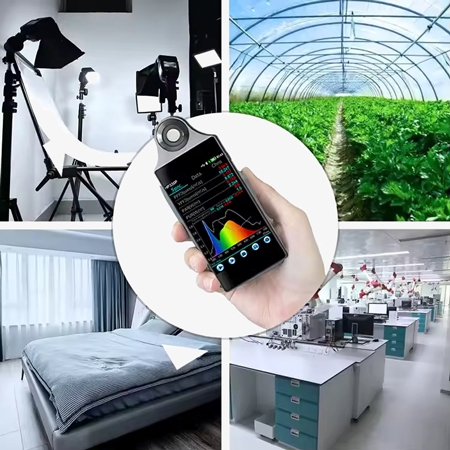
Dual Precise Measurement of Color Rendering and Wide Color Temperature
- Utilizing a long-focal-length cross-asymmetric CT spectrophotometer system and a high-precision CCD sensor, it achieves a spectral resolution of 0.2 nm, accurately measuring the full spectral range of 380 nm to 780 nm. Through the spectral distribution map mode, it can display the spectral power distribution curve of the light source in real time.
- The lux meter device boasts a color rendering accuracy of ±1.5% and a wide color temperature range of 1,000 K to 100,000 K, accurately measuring the color temperature (CCT) and color rendering index (Ra) of the light source.
- Directly measure PPFD, PAR, YPFD, and PUR, covering key radiometric parameters in plant photosynthesis research and assessing the actual contribution of light sources to plant photosynthesis.

On-site screening, Refined Back-end Analysis
- Graphical display modes such as CIE1931/1960/1976 chromaticity diagrams and color tolerance elliptic graphs can intuitively present parameters such as color tolerance (SDCM) and dominant wavelength of the light source, providing rich light and color visualization and professional analysis functions.
- The Lux Reader has a built-in lithium battery that supports 16 hours of continuous operation. Its lightweight aluminum alloy body (200g) is suitable for handheld operation and can be used in a wide temperature range of -10℃ to 45℃, allowing for sampling of light parameters in the plant growth environment anytime, anywhere.
- It connects to professional PC software via Type-C interface or Bluetooth for in-depth analysis and supports exporting source files, PDF, Excel, and other formats.
Applications
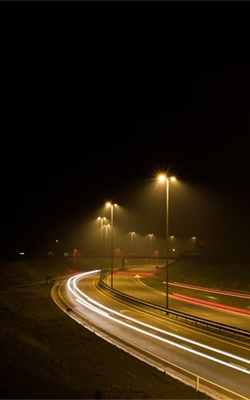
SISCO's lux meters are widely used for light monitoring and measurement in lighting enterprises, agriculture and livestock, industry and mining, laboratories, offices, medical institutions, home applications, street lighting construction and other industries.

School

Factory
Workshop

Office
| Model | SISCO-LM-HP33 |
| Wavelength Range | 380nm~780nm |
| Spectroscopic Mode | Long-focal cross-sectional asymmetric CT beam splitting system |
| Sensor | High-precision CCD |
| Spectral Bandwidth (FWHM) | 2nm |
| Spectral Resolution | 0.2nm |
| X,Y Coordinates |
X, Y accuracy ±0.0015 X, Y repeatability ±0.0005 |
| Wave Accuracy | ±0.5nm |
| Wavelength Data Output Interval | 1nm |
| Illuminance Accuracy | First order (±4% of readings ±1 reading). |
| Color Rendering Accuracy | ±1.5%, |
| Photosensitive Surface | Φ10mm |
| Screen Type | Mobile phones, computers, iPads, 3.5-inch touchscreens |
| Display Type | PC software, APP touchscreens |
| Chromaticity Coordinate Accuracy | ±0.0015 (Stability better than ±0.0005 relative to a standard light source traceable to NIM) |
| Color Temperature Range | 1,000K~100,000K. |
| Stray Light | ≤0.3% |
| Illuminance Measurement Range | 0.1~2000000 1x |
| Measurement Mode | Single test/continuous test |
| Spectral Display Mode | Spectral distribution diagram |
| Data Display Mode | All parameters can be displayed by sliding up and down |
| Graphic Display Mode | CIE1931 chromaticity diagram, CIE1960 chromaticity diagram, CIE1976 chromaticity diagram, Color tolerance elliptic graph, Color rendering index circular graph, Color rendering index bar graph |
| Integration Time | 50μs~10000ms |
| File Saving | Source file/PDF/Excel, etc. |
| Format Communication Interface | Type-C, Bluetooth |
| Operating Temperature/Humidity Range | (-10~40)℃, relative humidity <70% (non-condensing) |
| Storage Temperature/Humidity Range | (-20~45)℃, relative humidity <70% (non-condensing) |
| Zeroing Method | Automatic zeroing |
| Storage Capacity | Standard 4G (free) |
| Power Supply Method | Built-in lithium battery/power adapter |
| Continuous Operating Duration | Approximately 16 hours of use on a single charge |
| Overall Structure | All-aluminum alloy engraving |
| Main Unit Dimensions | 115mm×58mm×18mm |
| Weight | Approximately 200g (with battery, excluding accessories) |
Q1: What is a lux meter and how does it work?
A1: A lux meter, also known as an illuminance meter, is a device used to measure the amount of light falling on a surface. It works by using a photodiode or photovoltaic cell to convert light energy into an electrical signal, which is then processed and displayed as a reading in lux units.
Q2: What are some common applications of lux meters?
A2: Lux meters are commonly used in a variety of industries and settings, including photography, film production, architecture, and interior design. They are also used in industrial settings to ensure proper lighting levels for worker safety and productivity.
Q3: How to calibrate a lux meter?
A3: Calibrating a lux meter typically involves comparing its readings to a known standard light source of a specific brightness level. This can be done using a calibration light box or similar device, and the process may vary depending on the specific type and model of the lux meter being used. It is generally recommended to have a lux meter professionally calibrated on a regular basis to ensure accuracy.
Tips: How to correctly use a Lux Meter to measure illumination?
When using a Lux Meter to measure illumination correctly, the photosensitive sensor should be aligned parallel to the measurement surface. Avoid obstructing the view with your hands or other objects. Keep the sensor stable, minimize interference from reflected or oblique light, and select an appropriate measurement range based on the environment. If necessary, take the average of multiple measurements to obtain a more accurate illuminance reading.
Thank you for buying industrial test and measurement equipment on SISCO.com, all products sold by SISCO and the partner cover a 12 months warranty, effective from the date of receiving the products.
What is covered?
SISCO is responsible for providing free spare parts, and free technical support to assist the customer to repair the defective products until the problem is solved.
What is not covered?
- Product purchased from anyone other than a SISCO store or a SISCO authorized reseller.
- Expendable parts.
- Routine cleaning or normal cosmetic and mechanical wear.
- Damage from misuse, abuse or neglect.
- Damage from use of parts other than SISCO approved.
- Damage from use outside the product’s usage or storage parameters.
- Damage from use of parts not sold by SISCO.
- Damage from modification or incorporation into other products.
- Damage from repair or replacement of warranted parts by a service provider other than a SISCO authorized service provider.
- Damage caused by the application environment not meeting the product usage requirements and the failure to perform preventive maintenance.

Shop on sisco.com for all of your industrial test and measurement equipment & accessories including portable detectors, meters, testers, scales, etc.


