
This infrared CO2 sensor supports multiple signal output modes, including UART, PWM, and 0.4-2 V analog output. With its compact design and convenient interfaces, the infrared carbon dioxide sensor is suitable for HVAC systems, indoor air quality monitoring, industrial process and safety monitoring, agricultural and livestock environments, fresh-air systems, ventilation equipment, and carbon dioxide detection devices, making it suitable for OEM equipment and integrated CO₂ monitoring applications.
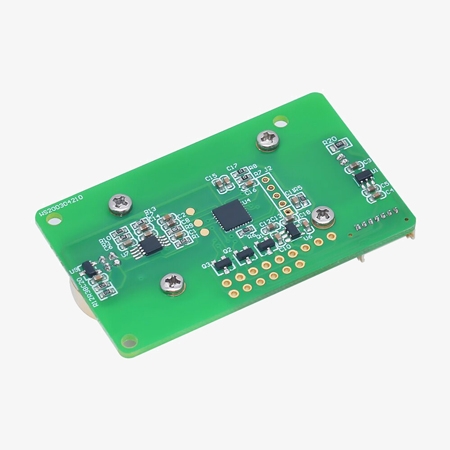
Multiple Signal Output Options
- Three Output Methods: Supports Analog, UART, and PWM outputs, providing flexible signal transmission options for different monitoring and control systems.
- UART Serial Output: The UART signal can be directly connected to the MCU IO serial port, using TTL level, 9600 baud, N, 8, 1 communication for convenient data transmission.
- Linear Analog Output: Provides a 0.4–2 V linear analog output, with the output voltage increasing as the detected CO₂ concentration rises, making it easy to connect with analog input systems.
- PWM Output: Features a PWM modulated waveform output, allowing CO₂ concentration data to be read and processed conveniently by compatible control systems.
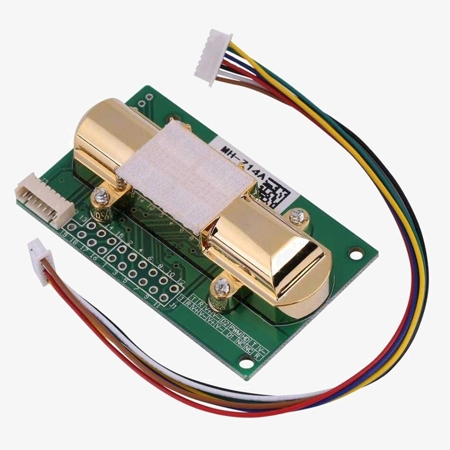
Metal Shielding Housing
- NDIR Infrared Technology: Uses Non-Dispersive Infrared (NDIR) technology to provide selective and reliable detection of carbon dioxide, making it suitable for continuous CO₂ monitoring.
- High Stability & Long Service Life: Designed for stable long-term operation with good measurement consistency and extended service life in suitable working environments.
- Compact & Lightweight: The small and lightweight module design saves installation space and makes it easy to integrate into CO₂ monitors, indoor air quality equipment, HVAC systems, environmental monitoring instruments, and OEM devices.
- Flexible System Integration: Multiple output options and the compact module structure make it suitable for integration into different CO₂ detection, monitoring, and control systems.
Applications
A CO2 Gas Sensor can be used in a wide range of applications where carbon dioxide concentration needs to be monitored, controlled, or analyzed. Common application fields include:
- Greenhouses & Agriculture: Monitoring and controlling CO₂ concentration to support plant growth and improve greenhouse environmental management.
- Laboratories: Suitable for laboratory equipment and environmental monitoring systems requiring accurate CO₂ measurement.
- Food & Beverage Industry: Used for monitoring CO₂ levels during food processing, beverage production, packaging, and storage.
- Medical & Healthcare Equipment: Integrated into certain respiratory and patient-monitoring equipment where CO₂ measurement is required.
- Automotive & Transportation: Used for monitoring cabin air quality in vehicles, buses, trains, and other enclosed transportation environments.

Greenhouses & Agriculture

Laboratories
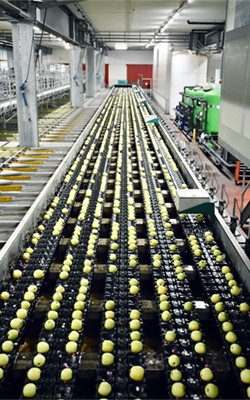
Food & Beverage Industry

Automotive
| Model | SISCO-GS-CO2-Z14A |
| Detection Gas | CO₂ |
| Working Voltage | 5 VDC |
| Peak Current | 125 mA |
| Average Current | < 40 mA |
| Interface Level | 3.3 V |
| Measuring Range | 400–10,000 ppm |
| Output Signal | UART / PWM / 0.4–2 V DC |
| Preheat Time | 1 min |
| Response Time | T90 < 120 s |
| Working Temperature | -10°C to 50°C |
| Working Humidity | 0–95% RH (Non-condensing) |
| Storage Temperature | -20°C to 60°C |
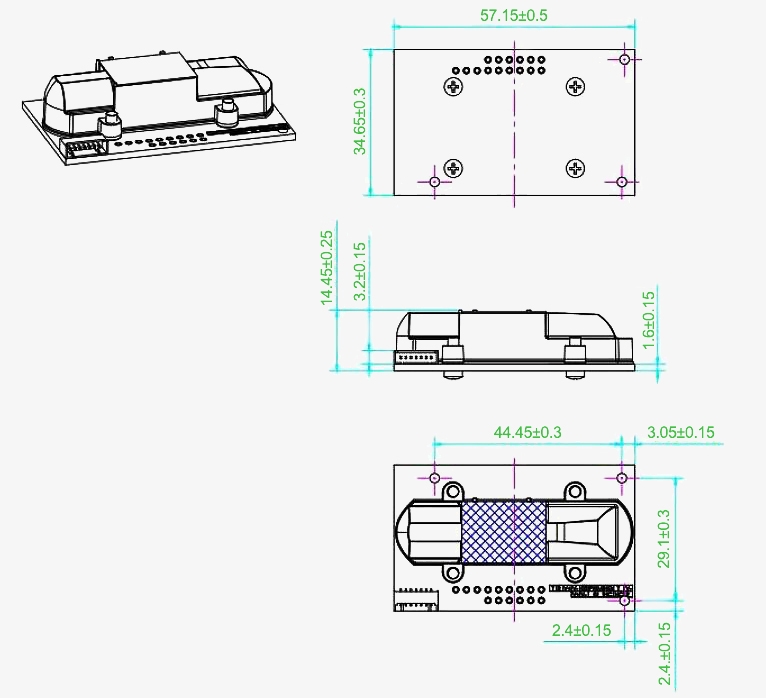
| Dimensions (L * W * H) | 57.5 * 34.7 * 17 mm |
| Weight | 30 g |
Measuring Range and Accuracy
| Target gas | Measuring range | Resolution | Accuacy |
| Carbon Dioxide (CO2) |
400~2000 ppm | 1 ppm | ± (50 ppm+5% reading value) |
|
400~5000 ppm |
|||
|
400~10000 ppm |
Dimension
Q1: What is a CO2 sensor?
A1: A CO2 sensor is a device used to measure the concentration of carbon dioxide in the air. It converts the detected CO₂ concentration into an electrical signal that can be displayed or processed by a monitoring or control system. CO₂ sensors are widely used in indoor air quality monitoring, HVAC systems, industrial equipment, greenhouses, and environmental monitoring.
Q2: How does a CO2 sensor work?
A2: SISCO CO₂ sensors use infrared sensing technology, particularly Non-Dispersive Infrared (NDIR) technology. The sensor measures how much infrared light is absorbed by carbon dioxide molecules in the air. The amount of infrared absorption is related to the CO₂ concentration, allowing the sensor to calculate and output a corresponding reading.
Q3: Can a CO2 sensor be integrated into an existing system?
A3: Yes. Many CO₂ sensor modules are designed for integration into larger systems and electronic equipment. Depending on the specific model, available communication or output interfaces may include UART, PWM, analog output, or other digital interfaces. Users should check the sensor's specifications to ensure electrical and communication compatibility.
Tips: Can humidity affect NDIR CO2 measurements?
Yes. Humidity can affect the accuracy of some NDIR CO₂ sensors, particularly when relative humidity changes significantly or reaches high levels. Water vapor can influence the infrared measurement and introduce a measurement deviation. Temperature can also affect NDIR accuracy, so many sensor designs use temperature and/or humidity compensation to improve stability.
For practical applications, an NDIR CO₂ sensor should be operated within its specified humidity range and, when possible, calibrated under environmental conditions similar to the intended application. Some NDIR modules incorporate environmental compensation to reduce the influence of temperature and humidity, helping maintain more reliable CO₂ readings in applications such as indoor air quality monitoring, HVAC systems, smart buildings, and environmental monitoring.
Thank you for buying industrial test and measurement equipment on SISCO.com, all products sold by SISCO and the partner cover a 12 months warranty, effective from the date of receiving the products.
What is covered?
SISCO is responsible for providing free spare parts, and free technical support to assist the customer to repair the defective products until the problem is solved.
What is not covered?
- Product purchased from anyone other than a SISCO store or a SISCO authorized reseller.
- Expendable parts.
- Routine cleaning or normal cosmetic and mechanical wear.
- Damage from misuse, abuse or neglect.
- Damage from use of parts other than SISCO approved.
- Damage from use outside the product’s usage or storage parameters.
- Damage from use of parts not sold by SISCO.
- Damage from modification or incorporation into other products.
- Damage from repair or replacement of warranted parts by a service provider other than a SISCO authorized service provider.
- Damage caused by the application environment not meeting the product usage requirements and the failure to perform preventive maintenance.

Shop on sisco.com for all of your industrial test and measurement equipment & accessories including portable detectors, meters, testers, scales, etc.


