
The Meteorological Visibility Meter is a powerful portable detection device. Compact in size and weighing less than 0.8kg, it comes with a professional instrument case, ensuring portability and safety. It is an efficient tool for outdoor operations and emergency testing.

High-Efficiency Visibility Detector for Multiple Environments
- The enclosed air sampling chamber design allows for real-time air exchange unaffected by external environmental interference, supporting visibility testing indoors and in various confined environments.
- Highly integrated design eliminates the need for complex calibration and debugging; simply plug it in and use. This is crucial for field inspections requiring rapid response, such as road safety patrols during sudden heavy fog, allowing staff to immediately activate the device for measurements.
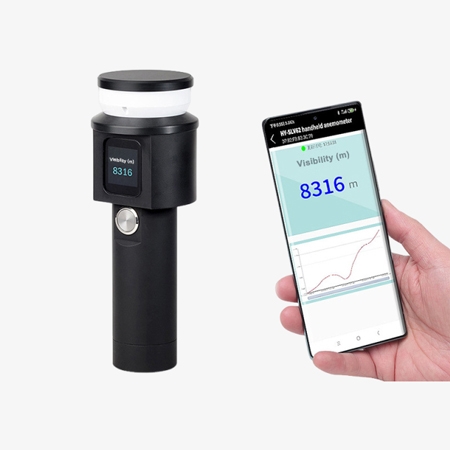
Wide Temperature Range Visibility Detector
- The visibility measuring instrument supports both handheld mobile detection and fixed-point monitoring modes, and can be easily mounted on a tripod. This functionality makes its application highly flexible: it can be used for rapid sampling inspections at different locations by hand, or as a small monitoring station for long-term, fixed observation at specific points, meeting diverse monitoring needs.
- A 2.5-inch touchscreen displays measurement data in real time. The measurement range covers 20 to 10,000 meters, and the operating ambient temperature ranges from -10°C to 65°C, ensuring stable operation in most climatic conditions.
Application
Portable visibility meter is widely used in traffic safety monitoring such as highway fog warning/airport runway visibility evaluation because of its lightweight and real-time measurement. On-site assessment of fire smoke/sandstorm in emergency disaster response; Study on air pollution in meteorological environmental protection observation; Environmental safety inspection of mountaineering, hiking or skiing in outdoor activities.

Aviation

Scientific Research
Smart Home

Agricultrue
| Model | SISCO-VM-JDSN10 |
| Measurement Range | 20m~10000m |
| Operating Environment | Temperature: -10℃~+65℃ |
| Humidity: 10~100% | |
| Data Display | Touch control display at 2.5m |
| Power Supply | Internal rechargeable lithium battery (continuous operation time greater than 72 hours) / charging adapter |
| Weight | Less than 0.8kg (excluding tripod) |
Q1: What is a portable visibility meter?
A1: Portable visibility meter is a kind of portable meteorological equipment for real-time measurement of atmospheric visibility, which is mainly used for safety monitoring in traffic, aviation, navigation and other fields. It is suitable for traffic safety early warning in low visibility weather (such as fog, haze, rain and snow), such as highways, airport runways and ship navigation.
Q2: How does a portable visibility meter work?
A2: The working principle of portable visibility meter is to retrieve visibility by measuring the intensity of scattered light from a specific angle by atmospheric particles. The visibility meter emits a beam of near-infrared light or laser to irradiate particles (fog drops, dust, etc.) in the atmosphere at a certain angle, and receives the scattered light signal of the forward scattering angle. The receiver converts the scattered light signal into an electrical signal, and the scattering coefficient (σ) is derived by a pre-calibrated algorithm, and it is assumed that the extinction coefficient (β ≈σ) is established under the condition of homogeneous atmosphere. According to the formula MOR = -ln(0.02)/β, the meteorological optical visual range (MOR) is calculated, and the visibility value is directly output.
Q3: What is a portable visibility meter used for?
A3: Traffic safety monitoring: real-time detection of road visibility in foggy, rainy and snowy weather, providing early warning data for highways, airport runways and ship trips.
Emergency disaster response: quickly deploy and monitor disaster sites such as fires and sandstorms to provide real-time visibility data for rescue operations.
Meteorological environmental protection application: supplement the monitoring blind area of fixed weather stations and evaluate the degree of air pollution.
Agricultural disaster prevention: monitoring farmland fog to prevent frost disaster.
Major event guarantee: provide weather monitoring for outdoor activities such as sports events.
Tips: Visibility measurements are better suited for trend assessment than instantaneous decision-making.
Visibility meters respond rapidly to changes in particulate matter and water droplets in the air under complex weather conditions such as fog, haze, rain, or snow. Therefore, short-term fluctuations in values are normal. Compared to single readings, continuous monitoring provides a more accurate reflection of the evolution of atmospheric transparency, making it particularly important for traffic control and meteorological analysis.
Thank you for buying industrial test and measurement equipment on SISCO.com, all products sold by SISCO and the partner cover a 12 months warranty, effective from the date of receiving the products.
What is covered?
SISCO is responsible for providing free spare parts, and free technical support to assist the customer to repair the defective products until the problem is solved.
What is not covered?
- Product purchased from anyone other than a SISCO store or a SISCO authorized reseller.
- Expendable parts.
- Routine cleaning or normal cosmetic and mechanical wear.
- Damage from misuse, abuse or neglect.
- Damage from use of parts other than SISCO approved.
- Damage from use outside the product’s usage or storage parameters.
- Damage from use of parts not sold by SISCO.
- Damage from modification or incorporation into other products.
- Damage from repair or replacement of warranted parts by a service provider other than a SISCO authorized service provider.
- Damage caused by the application environment not meeting the product usage requirements and the failure to perform preventive maintenance.

Shop on sisco.com for all of your industrial test and measurement equipment & accessories including portable detectors, meters, testers, scales, etc.


