
SISCO withstand voltage tester is a reliable and cost-effective solution for performing AC withstand voltage testing on a wide range of electrical products. This digital hipot tester includes essential safety features such as overcurrent protection and automatic test control, ensuring safe operation during high-voltage testing.
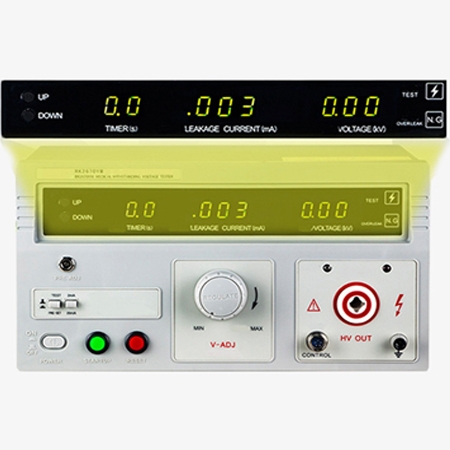
High-Brightness LED Digital Display
- High-Brightness LED Digital Display: The AC hipot tester features a high-brightness LED digital display, ensuring clear and accurate readings even in strong ambient lighting or industrial environments. Key parameters such as output voltage, leakage current, and test time are displayed prominently for easy monitoring.
- Excellent Visibility in All Conditions: The bright LED numeric display provides high contrast and wide viewing angles, allowing operators to read test data quickly from a distance. This is especially useful in production lines and workshop settings where lighting conditions may vary.
- Real-Time Data Monitoring: With the LED digital display, users can monitor voltage and current values in real time during testing, helping ensure precise control and immediate detection of abnormal conditions.
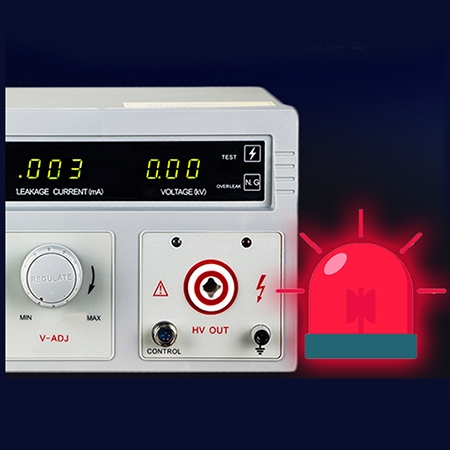
High-Brightness Red LED Indicator
- High-Brightness Red LED Indicator: The AC hipot tester is equipped with a high-brightness red LED indicator, providing a clear visual signal of the tester’s operating status. It helps operators quickly identify when the device is in active testing or high-voltage output mode.
- Enhanced Safety Awareness: The red LED serves as a high-voltage warning indicator, alerting users when the tester is energized. This significantly improves operator safety by reducing the risk of accidental contact during testing.
- Fast and Intuitive Operation Feedback: The LED indicator provides instant visual feedback during operation, allowing users to quickly confirm test start, ongoing status, or abnormal conditions without relying solely on the display screen.
Application
SISCO hipot tester is used to test the insulation strength of electrical devices and systems by applying a high voltage to ensure they can withstand electrical stress without breakdown. It is commonly applied in industries such as electronics, automotive, medical devices, telecommunications, power distribution, renewable energy, industrial machinery, and construction to verify electrical safety, prevent failures, and ensure compliance with safety standards.

Industrial

Renewable Energy

Construction

Automobile
| Model | SISCO-HT-RK2670YM |
| AC Output Voltage | 0 ~ 5 kV |
| AC Test Current | 0 ~ 2 / 20 mA |
| DC Test Current | Not Supported |
| Test Accuracy | ± (5% + 3 digits) |
| Test Time | 0.0 ~ 999 s (0.0 = Continuous Test) |
| Transformer Capacity | 100 VA |
| PLC Interface | Optional |
| Power Supply | AC 220 V ±10%, 50/60 Hz ±3 Hz |
| Operating Temperature | 0 ~ 40°C |
| Operating Humidity | ≤ 75% RH |
| Dimensions | 320 * 270 * 180 mm |
| Weight | 8.5 kg |
Q1: What is hipot tester?
A1: AC-DC test transformer, using advanced production equipment, using the coil winding epoxy vacuum casting and CD-type core of the new technology, and similar products compared to oil-immersed transformers, significantly reduce the weight, reduce the volume, in quality to improve the insulation strength and resistance to moisture degree, and effectively weaken the leakage of magnetic and greatly enhance the transformer to withstand the impact of test short-circuit current capacity.
Q2: Is high voltage testing destructive?
A2: Hipot (or high potential testing) is a non-destructive test that goes by many names: overvoltage testing, dielectric breakdown testing, dielectric withstand testing, or insulation resistance testing. Some of all of these tests are designed to make sure that the insulation materials used in your motor are doing their job.
Q3: What is the difference between the hipot and the Megger?
A3: Both instruments apply a relatively high voltage to the insulator and absorb leakage current through the insulator commensurate with its insulation characteristics and condition. However, the megohmmeter gives the operator a measured value, while the hipot acts.
Tips: Is AC hipot testing destructive?
AC hipot testing is generally considered non-destructive when performed under proper conditions, but it can become destructive if limits are exceeded or insulation is weak.
During an AC hipot test, a high voltage—higher than the normal operating voltage—is applied to a product to verify the integrity of its insulation system. When the test voltage, duration, and current limits are set according to relevant standards, the test does not damage properly designed and manufactured equipment. Instead, it confirms that the insulation can safely withstand electrical stress.
However, AC hipot testing is inherently a stress test, meaning it pushes the insulation close to its limits. If the insulation is defective, degraded, or poorly manufactured, the applied voltage may cause breakdown, arcing, or excessive leakage current, resulting in failure. In this case, the test is not creating the defect but revealing an existing weakness.
Thank you for buying industrial test and measurement equipment on SISCO.com, all products sold by SISCO and the partner cover a 12 months warranty, effective from the date of receiving the products.
What is covered?
SISCO is responsible for providing free spare parts, and free technical support to assist the customer to repair the defective products until the problem is solved.
What is not covered?
- Product purchased from anyone other than a SISCO store or a SISCO authorized reseller.
- Expendable parts.
- Routine cleaning or normal cosmetic and mechanical wear.
- Damage from misuse, abuse or neglect.
- Damage from use of parts other than SISCO approved.
- Damage from use outside the product’s usage or storage parameters.
- Damage from use of parts not sold by SISCO.
- Damage from modification or incorporation into other products.
- Damage from repair or replacement of warranted parts by a service provider other than a SISCO authorized service provider.
- Damage caused by the application environment not meeting the product usage requirements and the failure to perform preventive maintenance.

Shop on sisco.com for all of your industrial test and measurement equipment & accessories including portable detectors, meters, testers, scales, etc.


