
SISCO AC safety tester with its high output power and stable performance, this system is ideal for demanding industrial environments where reliability and safety are critical. Built in a robust cabinet structure with mobility support, the hipot tester is suitable for testing motors, transformers, cables, and other high-capacity electrical products.
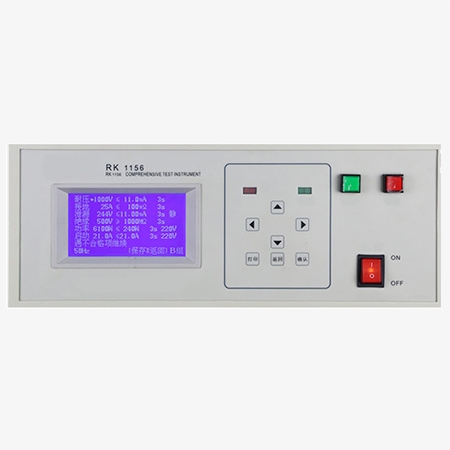
High-Brightness LED Digital Display
- High-Brightness LED Digital Display: The high voltage AC hipot tester features a high-brightness LED digital display, ensuring clear and accurate readings even in strong ambient lighting or industrial environments. Key parameters such as output voltage, leakage current, and test time are displayed prominently for easy monitoring.
- Excellent Visibility in All Conditions: The bright LED numeric display provides high contrast and wide viewing angles, allowing operators to read test data quickly from a distance. This is especially useful in production lines and workshop settings where lighting conditions may vary.
- Real-Time Data Monitoring: With the LED digital display, users can monitor voltage and current values in real time during testing, helping ensure precise control and immediate detection of abnormal conditions.
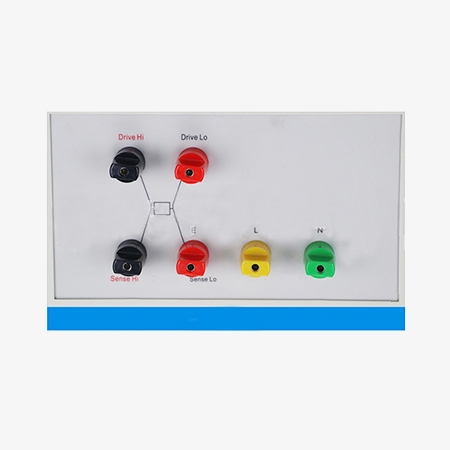
Multi-Terminal Output Interface Design
- Multi-Terminal Output Interface Design: The hipot tester is equipped with clearly labeled multi-terminal outputs, including Drive Hi / Drive Lo and Sense Hi / Sense Lo, enabling precise and flexible high-voltage testing connections.
- 4-Wire (Kelvin) Measurement Support: With dedicated sense terminals, the system supports 4-wire (Kelvin) measurement, effectively reducing lead resistance influence and ensuring high-accuracy test results, especially for low-resistance measurements.
- Color-Coded Terminals for Easy Identification: Each terminal is designed with distinct color coding (red, black, yellow, green), allowing operators to quickly identify connections such as Live (L) and Neutral (N), minimizing wiring errors and improving efficiency.
- Versatile Testing Configuration: This interface layout supports multiple test modes, including withstand voltage, grounding resistance, and leakage current testing, making the tester suitable for a wide range of electrical safety applications.
Application
SISCO hipot tester is used to test the insulation strength of electrical devices and systems by applying a high voltage to ensure they can withstand electrical stress without breakdown. It is commonly applied in industries such as electronics, automotive, medical devices, telecommunications, power distribution, renewable energy, industrial machinery, and construction to verify electrical safety, prevent failures, and ensure compliance with safety standards.

Industrial

Renewable Energy

Construction

Automobile
| Model | SISCO-HT-RK1156 |
| Withstand Voltage Test | |
| Output Voltage | AC 0 – 5000 V |
| Voltage Accuracy | ± (5% + 3 V) |
| Test Current | 0.02 – 11 mA |
| Current Accuracy | ± (5% + 3 digits) |
| Test Time | 1 – 300 s |
| Insulation Resistance Test | |
| Output Voltage | AC 200 – 1000 V |
| Voltage Accuracy | ± (5% + 3 V) |
| Resistance Range | 1.0 MΩ – 1000 MΩ |
| Accuracy (≤50 MΩ) | ± (5% + 0.5 MΩ) |
| Accuracy (>50 MΩ) | ± (10% + 10 MΩ) |
| Test Time | 1 – 300 s |
| Ground Bond Test | |
| Output Current | AC 10 – 25 A |
| Current Accuracy | ±5% |
| Resistance Range | 1–200 mΩ (11–25 A), 5–600 mΩ (10 A) |
| Resistance Accuracy | ± (5% + 3 mΩ) |
| Test Time | 1 – 300 s |
| Leakage Current Test | |
| Output Voltage | 1.03× / 1.11× input voltage (via isolation transformer) |
| Voltage Accuracy | ± (5% + 3 V) |
| Test Current | 0.05 – 11.00 mA |
| Current Accuracy | ± (5% + 3 digits) |
| Test Time | 1 – 300 s |
| Power Test | |
| Output Voltage | 1.0× Input Voltage (via isolation transformer) |
| Voltage Accuracy | ± (2% + 3 V) |
| Test Current | 0.1 – 20.00 A |
| Current Accuracy | ± (2% + 3 mA) |
| Test Power | 0 – 3000 W |
| Power Accuracy | ± (2% + 3 W) |
| Test Time | 1 – 300 s |
| Start-Up Test | |
| Output Voltage | 0.80× / 0.85× / 0.90× input voltage |
| Voltage Accuracy | ± (5% + 3 V) |
| Test Current | 0.1 – 20.00 A |
| Current Accuracy | ± (5% + 0.03 A) |
| Test Time | 1 – 300 s |
| General Specifications | |
| Power Supply | AC 200 V ±10%, 50 Hz ±5% |
| No-load Power Consumption | Approx. 30 W |
| Operating Temperature | 20 ±10°C |
| Operating Humidity | ≤ 60% RH |
| Dimensions | 1160 * 558 * 1466 mm |
| Weight | 70 kg |
Q1: What is hipot tester?
A1: AC-DC test transformer, using advanced production equipment, using the coil winding epoxy vacuum casting and CD-type core of the new technology, and similar products compared to oil-immersed transformers, significantly reduce the weight, reduce the volume, in quality to improve the insulation strength and resistance to moisture degree, and effectively weaken the leakage of magnetic and greatly enhance the transformer to withstand the impact of test short-circuit current capacity.
Q2: Is high voltage testing destructive?
A2: Hipot (or high potential testing) is a non-destructive test that goes by many names: overvoltage testing, dielectric breakdown testing, dielectric withstand testing, or insulation resistance testing. Some of all of these tests are designed to make sure that the insulation materials used in your motor are doing their job.
Q3: What is the difference between the hipot and the Megger?
A3: Both instruments apply a relatively high voltage to the insulator and absorb leakage current through the insulator commensurate with its insulation characteristics and condition. However, the megohmmeter gives the operator a measured value, while the hipot acts.
Tips: Is high voltage AC hipot testing safe?
Yes, high voltage AC hipot testing is safe when performed correctly and with proper precautions.
High voltage AC hipot testers are designed with multiple built-in safety features to protect both the operator and the equipment. These typically include overcurrent protection, arc detection, automatic discharge, and emergency stop functions, which help prevent accidents during high-voltage testing.
However, because the test involves applying voltages significantly higher than normal operating levels, it does carry inherent risks if misused. To ensure safe operation:
Operators should follow standard testing procedures and safety guidelines
Proper grounding and insulation must be ensured before testing
The test area should be clearly marked and restricted during operation
Only trained personnel should operate the equipment
When used under the correct conditions, high voltage AC hipot testing is a reliable and safe method for verifying electrical insulation performance.
Thank you for buying industrial test and measurement equipment on SISCO.com, all products sold by SISCO and the partner cover a 12 months warranty, effective from the date of receiving the products.
What is covered?
SISCO is responsible for providing free spare parts, and free technical support to assist the customer to repair the defective products until the problem is solved.
What is not covered?
- Product purchased from anyone other than a SISCO store or a SISCO authorized reseller.
- Expendable parts.
- Routine cleaning or normal cosmetic and mechanical wear.
- Damage from misuse, abuse or neglect.
- Damage from use of parts other than SISCO approved.
- Damage from use outside the product’s usage or storage parameters.
- Damage from use of parts not sold by SISCO.
- Damage from modification or incorporation into other products.
- Damage from repair or replacement of warranted parts by a service provider other than a SISCO authorized service provider.
- Damage caused by the application environment not meeting the product usage requirements and the failure to perform preventive maintenance.

Shop on sisco.com for all of your industrial test and measurement equipment & accessories including portable detectors, meters, testers, scales, etc.


