
High performance withstand voltage tester provides reliable performance for routine safety compliance checks. This high voltage withstand voltage tester with built-in memory groups and multiple test modes, the RK7122 supports flexible test management for different products, its intuitive interface and simple operation allow users to quickly configure test parameters, reducing setup time and improving testing efficiency.
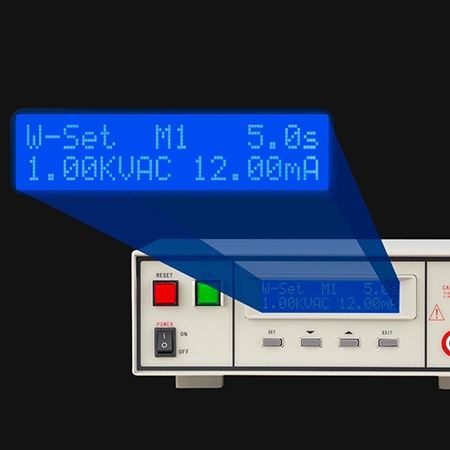
LCD Backlit LCD Screen
- Backlit LCD Display: Equipped with a high-contrast LCD screen with backlight, ensuring clear visibility of voltage, current, and test status even in low-light or dark environments.
- Easy-to-Read Interface: Large digital characters and intuitive layout allow operators to quickly read test results, reducing errors and improving efficiency on production lines.
- Real-Time Data Monitoring: Displays voltage, leakage current, and test time simultaneously, enabling users to monitor test conditions in real time.
- User-Friendly Operation: Clear menu structure and display prompts make setup and operation simple, even for first-time users.
- Status Indication at a Glance: The screen clearly shows PASS/FAIL results along with visual indicators, helping operators make quick judgments.
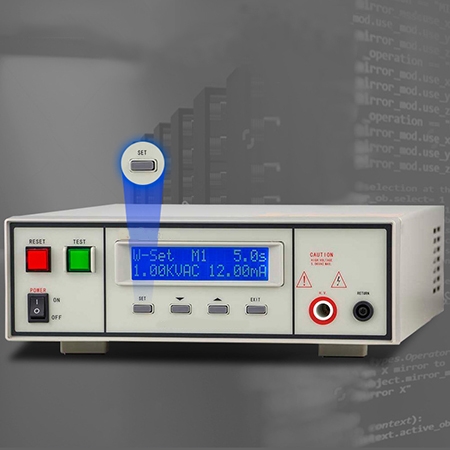
Five Memory Group Capacities; The "SET" Button Automatically Enters the Memory Group Setting Mode
- 5 Memory Groups Capacity: Built-in storage for up to five sets of test parameters, allowing users to quickly switch between different testing requirements without repeated setup.
- Quick Parameter Recall: Each memory group can store complete test settings (voltage, current limits, time, etc.), improving efficiency in multi-product production environments.
- One-Key Setup Access: Press the “SET” key to automatically enter the memory group configuration mode, simplifying parameter adjustment and saving time.
- Flexible Test Management: Ideal for production lines with multiple product types, enabling fast and accurate test configuration changes.
- Improved Workflow Efficiency: Reduces manual input errors and ensures consistency by reusing pre-saved test programs.
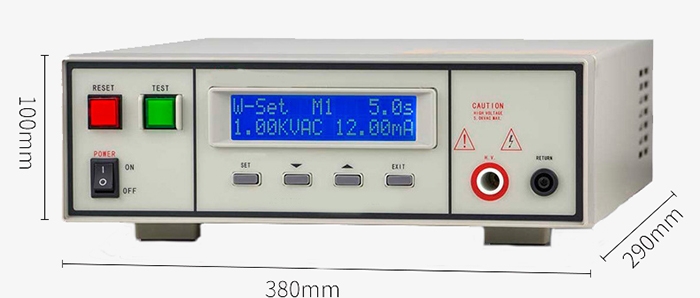
Dimension
Application
SISCO hipot tester is used to test the insulation strength of electrical devices and systems by applying a high voltage to ensure they can withstand electrical stress without breakdown. It is commonly applied in industries such as electronics, automotive, medical devices, telecommunications, power distribution, renewable energy, industrial machinery, and construction to verify electrical safety, prevent failures, and ensure compliance with safety standards.

Industrial

Renewable Energy

Construction

Automobile
| Model | SISCO-HT-RK7122 |
| Withstand Voltage Test | Yes |
| Output Voltage (Hipot) | AC: 0 ~ 5 kV; DC: 0 ~ 6 kV |
| Output Accuracy | ± (2% of setting + 5V) |
| Test Current Range | AC: 0.10 ~ 12.00 mA; DC: 0.10 ~ 5.00 mA |
| Current Accuracy | ± (2% of setting + 2 Counts) |
| Insulation Resistance Test | Yes |
| Insulation Output Voltage | DC: 0.10 ~ 1.00 kV |
| Resistance Range | 1 ~ 1000 MΩ |
| Resistance Accuracy | ± (5% reading + 2 Counts), DC ≥ 500V± (7% reading + 2 Counts), DC < 500V |
| Display Accuracy | ± (2% of setting + 1 Count) |
| Test Time | 0.2 ~ 999.9 s |
| Output Frequency | 50Hz / 60Hz (Selectable) |
| Input Power | Single phase 47 ~ 63Hz, 115V / 230V AC ±15% (Selectable) |
| Communication Interface | Input: Test / Reset; Output: Pass / Fail / Test / Process |
| Alarm System | Buzzer, LCD display “FAIL”, Indicator light |
| Memory Groups | 5 groups, each with 4 test modes (W, IW→I, I→W automatic) |
| Keyboard Lock | Optional: Lock / Unlock |
| Dimensions | 390 * 280 * 90 mm |
| Weight | 8.5 kg |
Q1: What is hipot tester?
A1: AC-DC test transformer, using advanced production equipment, using the coil winding epoxy vacuum casting and CD-type core of the new technology, and similar products compared to oil-immersed transformers, significantly reduce the weight, reduce the volume, in quality to improve the insulation strength and resistance to moisture degree, and effectively weaken the leakage of magnetic and greatly enhance the transformer to withstand the impact of test short-circuit current capacity.
Q2: Is high voltage testing destructive?
A2: Hipot (or high potential testing) is a non-destructive test that goes by many names: overvoltage testing, dielectric breakdown testing, dielectric withstand testing, or insulation resistance testing. Some of all of these tests are designed to make sure that the insulation materials used in your motor are doing their job.
Q3: What is the difference between the hipot and the Megger?
A3: Both instruments apply a relatively high voltage to the insulator and absorb leakage current through the insulator commensurate with its insulation characteristics and condition. However, the megohmmeter gives the operator a measured value, while the hipot acts.
Tips: What is an AC/DC withstand voltage tester?
An AC/DC withstand voltagetester (hipot tester) is a device used to check the insulation strength of electrical products. It applies a high voltage (AC or DC) between conductive parts and the product’s housing or ground to ensure there is no breakdown or excessive leakage current.
This test helps detect insulation defects and ensures the product is safe to use. It is widely used in manufacturing and quality control to meet safety standards and prevent risks like electric shock or short circuits.
Thank you for buying industrial test and measurement equipment on SISCO.com, all products sold by SISCO and the partner cover a 12 months warranty, effective from the date of receiving the products.
What is covered?
SISCO is responsible for providing free spare parts, and free technical support to assist the customer to repair the defective products until the problem is solved.
What is not covered?
- Product purchased from anyone other than a SISCO store or a SISCO authorized reseller.
- Expendable parts.
- Routine cleaning or normal cosmetic and mechanical wear.
- Damage from misuse, abuse or neglect.
- Damage from use of parts other than SISCO approved.
- Damage from use outside the product’s usage or storage parameters.
- Damage from use of parts not sold by SISCO.
- Damage from modification or incorporation into other products.
- Damage from repair or replacement of warranted parts by a service provider other than a SISCO authorized service provider.
- Damage caused by the application environment not meeting the product usage requirements and the failure to perform preventive maintenance.

Shop on sisco.com for all of your industrial test and measurement equipment & accessories including portable detectors, meters, testers, scales, etc.


