
This lab rotating mixer is engineered for extended continuous operation, powered by a brushless motor for stable, long-service-life performance with minimal maintenance. With a timer range of 1–1199 min and 40W rated power, it handles gentle, thorough mixing of biological samples in tubes from 1.5 to 50 ml, effectively preventing sample denaturation and bubble formation throughout the run. Widely used for immunoprecipitation, blood anticoagulation, latex diagnostics, and other demanding laboratory mixing applications, this tube rotator delivers the reliability and versatility that high-throughput life science labs require.
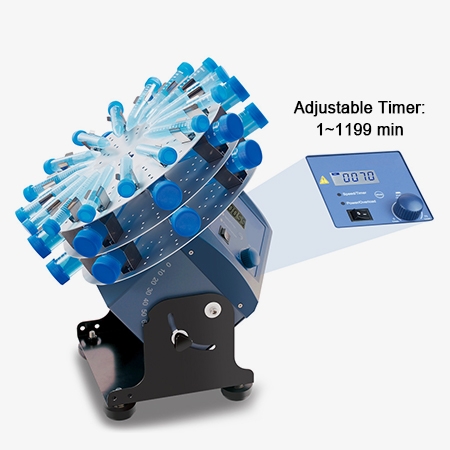
LCD Real-Time Display with Precise, Stepless Speed Control
- This lab tube rotator is equipped with an LCD that simultaneously shows current rotation speed and elapsed time in real time, giving lab personnel at-a-glance visibility of operating parameters throughout the run. Clear, accurate readouts reduce the risk of input errors and support consistent, reproducible experimental conditions, particularly important in regulated or high-throughput laboratory environments.
- The speed of the mixer is adjustable across the full 10~70 rpm range, allowing users to dial in the precise rotation rate suited to each sample's viscosity and sensitivity. Lower speeds provide gentle tumbling ideal for shear-sensitive materials such as cells and proteins, while higher speeds deliver more vigorous mixing for denser suspensions — all without risk of overshooting the sample's tolerance.
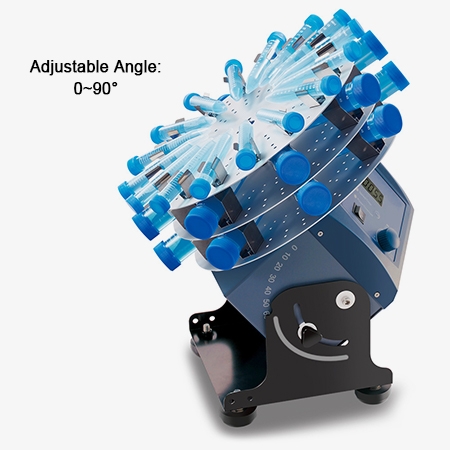
Adjustable 0~90° Mixing Angle and Double-Wheel Design for Higher Throughput
- The mixing angle is freely adjustable between 0° and 90°, giving users precise control over the tumbling dynamics inside each tube. At or near 0° (horizontal), the motion is smooth and gentle — well-suited for sensitive biological samples such as whole blood or antibody solutions where minimizing shear stress is a priority. At or near 90° (vertical), the increased tumbling amplitude drives more vigorous liquid movement, accelerating resuspension of settled particles or dissolution of solutes for applications where mixing efficiency is the primary concern.
- The double-wheel platform accommodates significantly more sample tubes per run than a single-wheel model, making it the preferred choice for high-throughput workflows that require parallel batch processing. Laboratories handling large sample volumes — such as immunoprecipitation panels, multi-sample diagnostics, or overnight incubation protocols — benefit directly from the increased capacity, reducing the number of sequential runs needed and maximizing overall productivity without increasing bench footprint.
Applications
Lab mixers are widely used in biomedical research for cell culture, PCR, and immunoassays, ensuring uniform and reliable mixing of samples. In the chemical industry and scientific laboratories, lab mixing equipment supports catalytic reactions, solution preparation, protein crystallization, and nucleic acid hybridization, improving experimental stability and repeatability. In clinical testing and diagnostics, laboratory vortex mixers are commonly used for preparing blood and urine samples and for antimicrobial susceptibility testing, ensuring accurate and dependable results.

Chemical Industry
Scientific Research

Clinical Testing

Biomedical Research
| Model | SISCO-LM-MX-RD-Pro |
| Speed Range | 10~70 rpm |
| Speed Display | LCD |
| Timer Display | LCD |
| Main Unit Adjustable Angle | 0~90° |
| Operating Mode | Continuous / Timed |
| Timer Setting Range | 1~1199 min |
| Motor Type | DC Brushless Motor |
| Power Supply | 100~240 V, 50/60 Hz |
| Rated Power | 40 W |
| Ambient Temp. & Humidity | 5~40°C, 80% RH |
| Enclosure Protection Rating | IP 21 |
| Dimensions (D × W × H) | (280×210×300) mm |
| Net Weight | 6 kg |
Note: The product is compatible with disk accessories and does not include centrifuge tube clamps. A 1.5 mL tube rack is included as standard.
Details
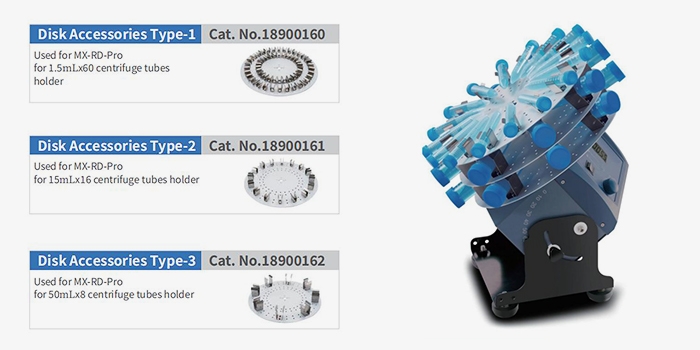
Q1: What are the main advantages of the double-wheel model over a single-wheel tube rotator?
A1: The double-wheel design's primary advantage is throughput — it accommodates more sample tubes simultaneously within the same bench footprint, making it considerably more efficient for batch processing and parallel sample workflows. Beyond capacity, this model also adds an LCD digital display for real-time parameter monitoring and a 0–90° adjustable mixing angle, giving users greater control over mixing intensity and motion dynamics compared to basic single-wheel rotators. For labs that need both higher volume and more precise mixing customization, the double-wheel model is the stronger investment.
Q2: How does adjusting the mixing angle affect experimental results in practice?
A2: The mixing angle determines how much the sample tumbles within the tube during rotation, which directly shapes the fluid dynamics and mixing intensity. At shallow angles (near 0°), the rotation is close to horizontal, producing a calm, rolling motion that is well-suited to shear-sensitive samples — such as those containing live cells, proteins, or nucleic acids — where preserving biological integrity is critical. At steeper angles (near 90°), the tube approaches vertical rotation, generating more forceful end-over-end tumbling that accelerates mixing, aids resuspension of particulates, and speeds up dissolution. Matching the angle to the sample type ensures you achieve complete mixing without compromising sample quality.
Q3: Why is a brushless motor particularly well-suited for long-duration lab mixing runs?
A3: Brushless motors eliminate the carbon brush contact mechanism of conventional motors, fundamentally reducing mechanical friction, heat generation, and component wear. The result is quieter operation, greater speed stability, a significantly longer service life, and no need for periodic brush replacement — lowering long-term maintenance costs. Combined with this mixer's timer range of up to 1199 min, the brushless motor makes it fully capable of sustained overnight runs, extended incubation protocols, and other time-intensive workflows where reliability over many consecutive hours is non-negotiable.
Tips: How do you use the angle adjustment to get the best mixing results for different sample types?
The 0~90° adjustable mixing angle is one of the features that sets this double-wheel tube rotator apart from standard rotating mixers — and using it thoughtfully can make a meaningful difference in mixing quality across different sample types. As a practical starting point:
- For free-flowing liquid samples such as whole blood or serum, a shallow angle paired with a mid-range speed delivers gentle, uniform mixing while minimizing the risk of hemolysis or foam formation.
- For suspensions containing solid particles or precipitates, increasing the angle increases the tumbling amplitude, accelerating resuspension, and ensuring particles are evenly distributed throughout the solution.
- When working with a new sample type for the first time, it's good practice to begin at a low angle and low speed, observe how the liquid moves within the tube, and adjust incrementally from there — rather than jumping straight to high-angle, high-speed settings. This cautious approach helps prevent spillage, unwanted phase separation, or sample damage, and provides a reliable baseline for future runs with the same material.
Thank you for buying industrial test and measurement equipment on SISCO.com, all products sold by SISCO and the partner cover a 12 months warranty, effective from the date of receiving the products.
What is covered?
SISCO is responsible for providing free spare parts, and free technical support to assist the customer to repair the defective products until the problem is solved.
What is not covered?
- Product purchased from anyone other than a SISCO store or a SISCO authorized reseller.
- Expendable parts.
- Routine cleaning or normal cosmetic and mechanical wear.
- Damage from misuse, abuse or neglect.
- Damage from use of parts other than SISCO approved.
- Damage from use outside the product’s usage or storage parameters.
- Damage from use of parts not sold by SISCO.
- Damage from modification or incorporation into other products.
- Damage from repair or replacement of warranted parts by a service provider other than a SISCO authorized service provider.
- Damage caused by the application environment not meeting the product usage requirements and the failure to perform preventive maintenance.

Shop on sisco.com for all of your industrial test and measurement equipment & accessories including portable detectors, meters, testers, scales, etc.


