
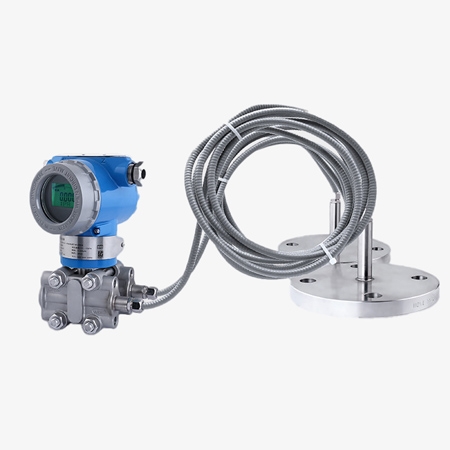
SISCO liquid differential pressure sensor features high insulation performance with ≥100MΩ insulation resistance (500VDC) and 500VAC insulation strength, ensuring safe and stable operation. The IP66 protection rating helps prevent dust and water ingress after electrical connection, while the -20~70℃ operating range supports reliable performance in different environments.

Accurate Measurement & Smart Configuration
- The liquid differential pressure sensor uses a monocrystalline silicon sensor core for high accuracy and strong overload resistance.
- Supports measurement of liquid level, volume, density, and differential pressure for flexible process monitoring.
- HART communication enables onsite adjustment of range, zero point, damping, and other parameters.
Reliable Performance in Harsh Conditions
- Double-flange capillary structure supports applications with corrosive and high-temperature media.
- Available with intrinsically safe, flame-proof, and dust-proof explosion protection options.
- Multiple diaphragm materials, including 316L, Hastelloy-C, and tantalum, provide excellent corrosion and temperature resistance.
- Die-cast metal housing delivers strong durability for long-term industrial use.
Applications
This liquid differential pressure sensor is engineered for liquid-medium measurement, widely deployed in oil & natural gas industries, including oil platforms, refineries, gas pipelines, oil-gas tank trucks, and fracturing vehicles. It also serves petrochemical and chemical facilities for pipeline monitoring, chemical liquid detection, tank farm measurement, and condensate separator operation. Besides, it delivers reliable liquid level measurement for various closed-type storage tanks across industrial processes.

Petroleum and Natural Gas

Chemical Equipment

Sealed Tanks
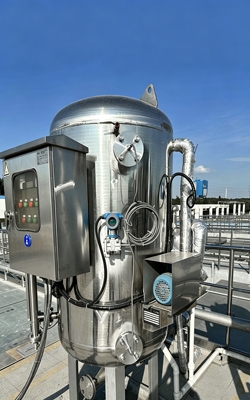
Stainless Steel Vessels
| Model | SISCO-DPS-CYYZ3051SA |
| Measuring medium | Liquid (compatible with contact material) |
| Pressure mode | Differential pressure |
| Medium temperature (Depends on filling fluid) |
Silicone oil (conventional medium, applicable medium temperature -40~205℃) |
| High temperature silicone oil (conventional medium, applicable medium temperature -40~300℃) | |
| Mineral oil (sanitary filling fluid, applicable medium temperature -20~170℃) | |
| Fluorine oil (special filling fluid for oxygen, applicable medium temperature -40~170℃) | |
| Range | -40kPa~40kPa/-100kPa~100kPa/-250kPa~250kPa/-500kPa~1MPa |
| Output signal | 4-20mA HART protocol |
| Power supply range | 12~32VDC, 15~24VDC (special for intrinsic safety type) |
| Maximum power | ≤0.02Us (W) |
| Connection time | 20ms |
| Stable performance | ±0.05%URL/year |
| Explosion-proof grade (Intrinsic safety power must be provided by safety barriers or intrinsic safety power sources) |
Explosion-proof type Ex d IIC T6 Gb |
| Explosion-proof-dust type Ex tb IIIC T80℃ Db | |
| Intrinsic safety type Ex ia IIC T6 Ga | |
| Dust-intrinsic-safety type Ex ia IIIC T200 80℃ Da | |
| Protection level | IP66 (after electrical connection is complete) |
| Response frequency | The time constant is adjustable, increasing by 0.1 seconds, from as low as 32 seconds. If the damping time is 0, the default is 0.1 (the minimum is 0.1) |
| Insulation resistance | ≥100MΩ, 500VDC |
| Insulation strength | 500VAC |
| Environmental temperature | -20~70℃ |
| Environmental humidity | 0%~95%RH (no condensation and no condensation) |
| Flange material | 304 stainless steel |
| Diaphragm material | 316L stainless steel/Hastelloy C/Tantalum (No coating; please contact us if coating is required) |
| Certification | CE |
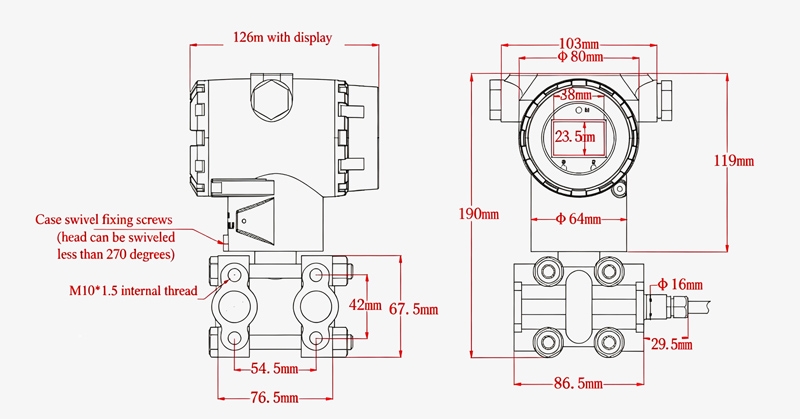
Dimensions (unit: mm)
Flange size (mm)
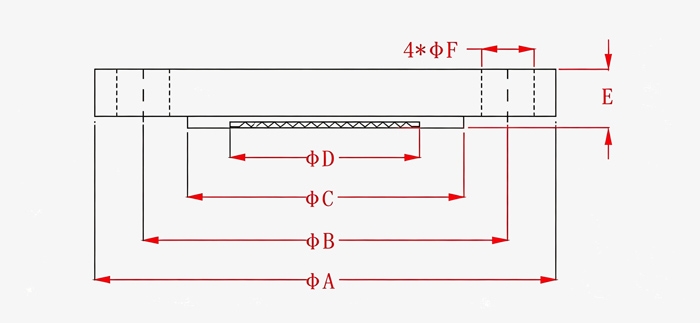
| Nominal diameter | A | B | F | Number of bolt holes | C | D | E | Pressure resistance (MPa) |
| DN50 | 165 | 125 | 18 | 4 | 95 | 60 | 18 | 1.6 |
| DN80 | 200 | 160 | 18 | 8 | 127 | 84 | 20 | 1.6 |
| DN100 | 220 | 180 | 18 | 8 | 157 | 84 | 20 | 1.6 |
Wiring diagram
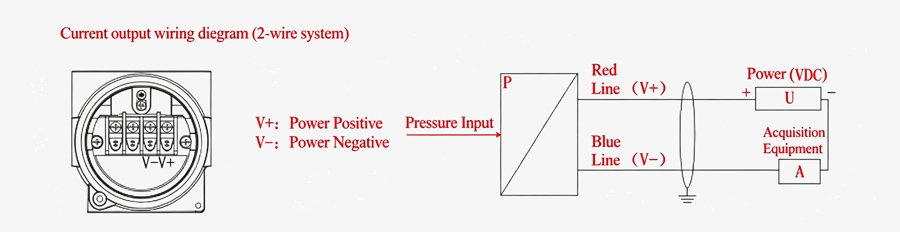

Q1: What is the difference between a differential pressure sensor and a pressure sensor?
A1: A standard pressure sensor measures pressure relative to a reference pressure, usually atmospheric pressure. A liquid differential pressure sensor measures the pressure difference between two connection points, making it more suitable for applications such as liquid level measurement, flow monitoring, and filter condition monitoring.
Q2: How does a liquid differential pressure sensor work?
A2: A liquid differential pressure sensor works by using a sensing element, such as a monocrystalline silicon sensor core, to detect pressure differences between two ports. The measured differential pressure is converted into an electrical signal that can be transmitted to control systems through interfaces such as 4-20mA HART communication for real-time monitoring and adjustment.
Q3: Is a liquid differential pressure sensor suitable for outdoor installation?
A3: Yes, many industrial liquid differential pressure sensors are designed for outdoor environments. Models with proper housing protection, such as IP66 protection, can provide better resistance against dust and water exposure after electrical connection.
Tips: What protection classes are available for the liquid differential pressure sensors?
The liquid differential pressure sensors are available with IP66 protection, intrinsically safe, flame-proof, and dust-proof protection classes to meet different industrial application requirements.
- IP66 protection: Provides dust-tight protection and resistance against water jets after electrical connection is completed, making it suitable for outdoor, humid, and industrial environments.
- Intrinsically safe protection: Limits electrical energy to prevent ignition risks and is suitable for hazardous areas with flammable gases or vapors.
- Flame-proof protection: Designed to contain internal explosions and prevent flame transmission, ensuring safer operation in hazardous industrial locations.
- Dust-proof protection: Helps prevent dust particles from entering the sensor housing, improving reliability in dusty working conditions.
Thank you for buying industrial test and measurement equipment on SISCO.com, all products sold by SISCO and the partner cover a 12 months warranty, effective from the date of receiving the products.
What is covered?
SISCO is responsible for providing free spare parts, and free technical support to assist the customer to repair the defective products until the problem is solved.
What is not covered?
- Product purchased from anyone other than a SISCO store or a SISCO authorized reseller.
- Expendable parts.
- Routine cleaning or normal cosmetic and mechanical wear.
- Damage from misuse, abuse or neglect.
- Damage from use of parts other than SISCO approved.
- Damage from use outside the product’s usage or storage parameters.
- Damage from use of parts not sold by SISCO.
- Damage from modification or incorporation into other products.
- Damage from repair or replacement of warranted parts by a service provider other than a SISCO authorized service provider.
- Damage caused by the application environment not meeting the product usage requirements and the failure to perform preventive maintenance.

Shop on sisco.com for all of your industrial test and measurement equipment & accessories including portable detectors, meters, testers, scales, etc.


