
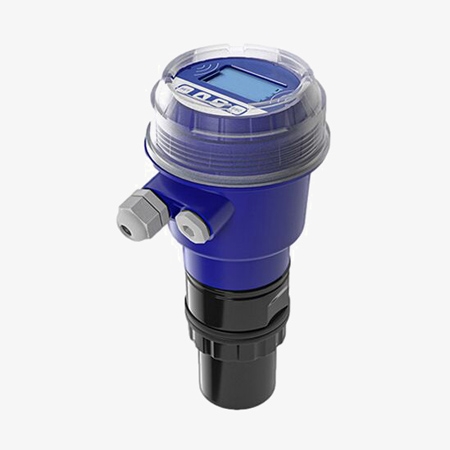
SISCO ultrasonic level sensor delivers accurate and reliable liquid level measurement with advanced ultrasonic sensing technology. Featuring 4-20mA analog output and RS485 communication with Modbus-RTU protocol, it ensures seamless integration with industrial control systems. Powered by 18-28VDC, with flexible M20×1.5/M16×1.5 connections and wide temperature resistance, it is ideal for water treatment, storage tanks, and industrial automation applications.
Measurement Performance & Intelligent Technology
- Advanced Ultrasonic Technology: Non-contact ultrasonic level transmitter adopts intelligent algorithms to ensure stable measurement performance in complex environments.
- Non-contact Level Measurement: Measures liquid levels without direct contact, minimizing sensor contamination while improving reliability and service life.
- Automatic Calibration: Multi-point calibration of the non-contact ultrasonic level meter improves accuracy and provides complete measurement data traceability.
- Smart Self-diagnosis: Built-in fault code system enables fast troubleshooting and simplifies on-site equipment maintenance.
User-friendly Operation & Display Interface
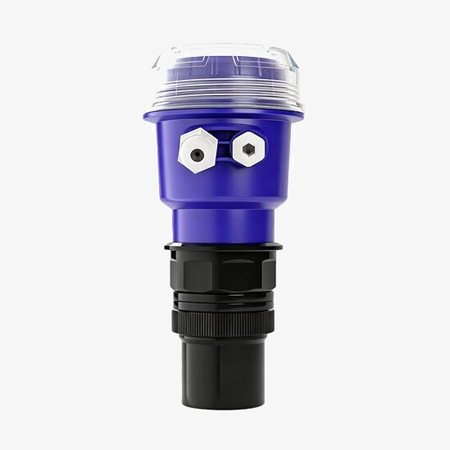
- Integrated Display Screen: Real-time display of level distance, output current, temperature, and key operating parameters supports intuitive operation of the non-contact ultrasonic level sensor.
- Local Control Panel: Supports quick parameter configuration directly on site without requiring additional programming equipment.
Applications
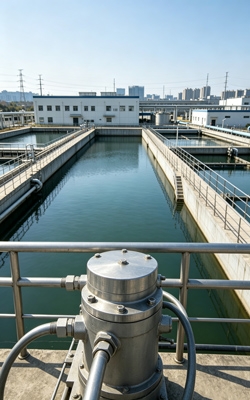
Improve your liquid level monitoring efficiency with the non-contact ultrasonic level sensor, a reliable ultrasonic level sensor for outdoor and industrial applications. It provides accurate water level measurement for rivers, lakes, reservoirs, fire water tanks, sewage pools, and industrial storage tanks. Designed for wastewater treatment, chemical plants, and smart water management systems, it delivers stable performance with easy installation and minimal maintenance.

Rivers And Lakes

Water Tanks Ponds

Storage Transportation Tanks
Municipal Water Conservancy
| Model | SISCO-ULT-MIK-WSU180 |
| Measurement Variable | Level / Liquid Level |
| Measuring Range | 0-5m (0-10m optional) |
| Blind Zone | 5m range: ≤0.3m; 10m range: ≤0.4m |
| Accuracy | ±0.5%FS |
| Resolution | 1mm or 0.1%FS (whichever is greater) |
| Protection Rating | IP65 |
| Analog Output |
4-20mA, output accuracy 0.2%FS2-wire: load (0-18V)/0.02A, U = supply voltage 4-wire: load (0-14V)/0.02A, U = supply voltage |
| Alarm Output | 2-channel SPST (4-wire optional), 250VAC, 3A |
| Communication Output | RS485 (4-wire optional), Modbus-RTU protocol |
| Power Supply | (18-28)VDC |
| Power Consumption |
2-wire: max 0.48W 4-wire (passive relay, no analog output): max 0.4W 4-wire (1 relay on, no analog output): max 0.5W 4-wire (2 relays on, no analog output): max 0.7W 4-wire (no relay, with analog output): max 0.8W 4-wire (1 relay on, with analog output): max 0.9W 4-wire (2 relays on, with analog output): max 1.1W |
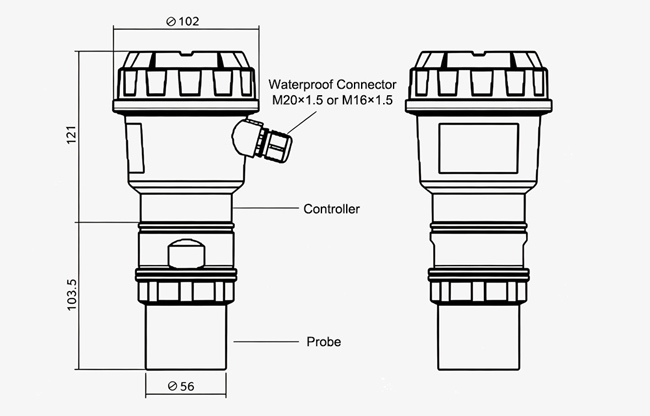
| Electrical Connection | M20×1.5 or M16×1.5 |
| Process Pressure | 0.3MPa |
| Operating Temperature | Transmitter: (-20~60)℃; Probe: (-40~80)℃ |
| Storage Temperature | (-20~80)℃ |
| Humidity | 10%-85% |
| Weight | 500g |
Dimensions (unit: mm)
Q1: What are the advantages of a non-contact ultrasonic level transmitter?
A1: A non-contact ultrasonic level sensor offers several advantages, including no direct contact with the measured medium, low maintenance, easy installation, and reliable continuous level monitoring. Since it measures level by transmitting and receiving ultrasonic waves without touching the material, it is suitable for corrosive, contaminated, or hygienic liquids where contact sensors may experience corrosion or fouling. With no moving parts, it provides stable operation and a longer service life while reducing maintenance requirements.
Q2: How long does a non-contact ultrasonic level transmitter last?
A2: A non-contact ultrasonic level meter typically lasts 5–10 years or longer under normal operating conditions, depending on the product quality, installation environment, and maintenance practices. Since it does not directly contact the measured medium and has no mechanical moving parts, it generally experiences less wear and requires less maintenance than contact-type level sensors. The service life can be affected by factors such as extreme temperatures, high humidity, dust, chemical vapors, electrical surges, and improper installation.
Q3: How does a non-contact ultrasonic level transmitter work?
A3: A non-contact ultrasonic level transmitter works by using ultrasonic waves to measure the distance between the sensor and the surface of a liquid or solid material without direct contact. The transmitter emits high-frequency ultrasonic pulses toward the material surface, and when the waves hit the surface, they are reflected to the sensor. The device calculates the travel time of the echo and converts it into a distance measurement. By knowing the tank height and the measured distance, the transmitter determines the material level and outputs the result through signals such as 4-20mA, RS485, or relay output.
Tips: What affects ultrasonic level measurement accuracy?
Several factors can affect ultrasonic level measurement accuracy, including the measured medium, installation conditions, environmental changes, and transmitter settings. Common factors include foam, vapor, turbulence, temperature variations, tank geometry, and incorrect installation. Foam or floating materials on the liquid surface can absorb or scatter ultrasonic waves, reducing echo strength and causing inaccurate readings. Temperature changes can affect the speed of sound and may require temperature compensation. Strong turbulence, agitators, or uneven surfaces can create unstable echoes, while obstacles such as pipes or tank structures in the ultrasonic beam path may cause false signals.
Thank you for buying industrial test and measurement equipment on SISCO.com, all products sold by SISCO and the partner cover a 12 months warranty, effective from the date of receiving the products.
What is covered?
SISCO is responsible for providing free spare parts, and free technical support to assist the customer to repair the defective products until the problem is solved.
What is not covered?
- Product purchased from anyone other than a SISCO store or a SISCO authorized reseller.
- Expendable parts.
- Routine cleaning or normal cosmetic and mechanical wear.
- Damage from misuse, abuse or neglect.
- Damage from use of parts other than SISCO approved.
- Damage from use outside the product’s usage or storage parameters.
- Damage from use of parts not sold by SISCO.
- Damage from modification or incorporation into other products.
- Damage from repair or replacement of warranted parts by a service provider other than a SISCO authorized service provider.
- Damage caused by the application environment not meeting the product usage requirements and the failure to perform preventive maintenance.

Shop on sisco.com for all of your industrial test and measurement equipment & accessories including portable detectors, meters, testers, scales, etc.


