
The portable spectrophotometer features a 3.5-inch TFT true-color touchscreen, full-spectrum LED illumination, and advanced SCI/SCE measurement technology, it provides reliable color data such as CIE LAB, ΔE, XYZ, Yxy, LCh, and CIE LUV. Its fast approximately 1-second measurement time makes it suitable for efficient quality inspection and color matching.
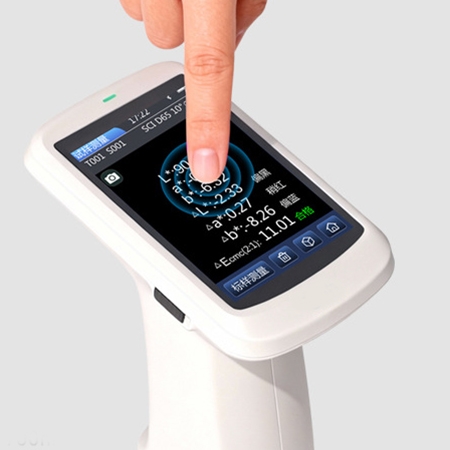
Extra-Large 3.5-Inch True-Color TFT Touchscreen
- 3.5-inch Large TFT Color Touchscreen: Features a 3.5-inch TFT true-color touchscreen for clear display of measurement results, settings, and test information.
- Intuitive Touch Operation: Responsive touch controls provide quick access to measurement modes, calibration, settings, and data management.
- Clear Real-Time Results: Displays spectral data, measurement values, and test status in an easy-to-read interface, helping users quickly evaluate samples.
- Easy Data Viewing: Measurement results can be viewed directly on the high-resolution screen, making on-site testing more convenient.
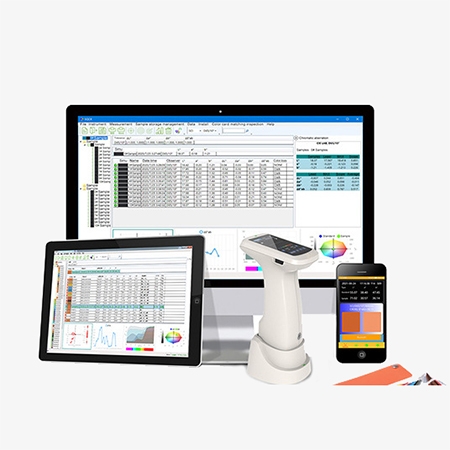
Powerful Expansion Capabilities and Collaborative Management
- Powerful Connectivity & Data Management: Supports flexible data communication and data management, making measurement results easier to transfer, analyze, and store.
- Multi-Device Collaboration: Enables seamless coordination with computers, mobile devices, or other systems for more efficient testing and centralized data management.
- Flexible System Expansion: Designed with expandable interfaces and functions to support different testing requirements and future application upgrades.
- Seamless Workflow Integration: Easily integrates into laboratory, production, and field testing workflows for convenient measurement, data sharing, and quality control.
Applications

Textile
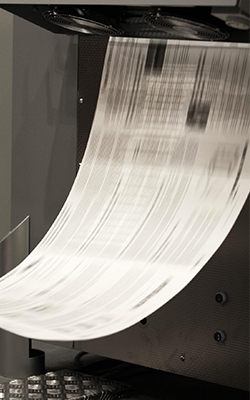
Printing

Paint
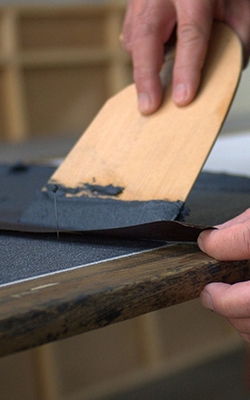
Dyeing and Printing
| Model | SISCO-CM-KS-100 | SISCO-CM-KS-200 | SISCO-CM-KS-210 | SISCO-CM-KS-220 |
| Illumination Geometry | D/8 (diffuse illumination, 8° viewing), SCI/SCE | |||
| Standards | CIE No.15, GB/T 3978, GB 2893, GB/T 1833, ISO 7724-1, ASTM E1164, DIN 5033 | |||
| Features | Dual optical path design for improved measurement stability; suitable for color quality control of plastics, paints, textiles, printing materials, ceramics, and other products | |||
| Light Source | Full-spectrum LED light source | |||
| Integrating Sphere Size | Φ40 mm | |||
| Optical System | High-precision optical components | |||
| Detector | Silicon photodiode array, dual-row 18-element | |||
| Wavelength Range | 400–700 nm | |||
| Wavelength Interval | 10 nm | |||
| Measurement Aperture | 4 apertures: 5 mm, 10 mm + platform and tip | 4 apertures: 5 mm, 10 mm + platform and tip | 6 apertures: 3/5/10 mm + platform and tip | 8 apertures: 3/3.5/5/10/10/11 mm + platform and tip |
| Measurement Geometry | Simultaneous SCI/SCE | |||
| Color Spaces | CIE LAB | CIE LAB, XYZ, Yxy, LCh, CIE LUV, s-RGB, HunterLab, βxy, DIN Lab99 | ||
| Color Difference Formulas | ΔE*ab | ΔEab, ΔEuv, ΔE94, ΔE CMC(2:1), ΔE CMC(1:1), ΔE00, DIN99 | ||
| Other Color Indices | — | WI, YI, ASTM E313, CIE/ISO, AATCC, Hunter, Taube, Berger, Stensby, ASTM D1925, ASTM E313, tint strength, color density, whiteness, yellowness, Munsell, CMYK, Tint, etc. | ||
| Observer Angle | 2° / 10° | |||
| Standard Illuminant | D65 | D65, A, B, C, D50, D55, D75, F1–F12, TL84, U30, U35, NBF, ID50, LED-B1 to LED-B5, LED-RGB, LED-V1, LED-V2, etc. | ||
| Display | Spectral data, sample color values, color difference, pass/fail result, color direction | |||
| Measurement Time | Approx. 1 s | |||
| Repeatability | Color value: MAV/SCI, standard deviation ΔE*ab ≤ 0.028; spectral reflectance ≤ 0.1% | |||
| Inter-Instrument Agreement | MAV/SCI, ΔE*ab ≤ 0.35 (average of 12 BCRA Series II color tiles) | |||
| Display Resolution | 0.01 | |||
| Reflectance Measurement Range | 0–200% | |||
| Reflectance Resolution | 0.01% | |||
| Measurement Mode | Single / Average measurement (2–999 times) | |||
| Positioning Method | Stable positioning + camera-assisted positioning | |||
| White Calibration | Contact white calibration | Non-contact automatic white calibration | ||
| Battery | 3.7 V, 3200 mAh; up to 8,000 measurements per charge | |||
| Light Source Life | More than 1.2 million measurements | |||
| Display Type | 3.5-inch TFT true-color capacitive touchscreen | |||
| Interfaces | USB, Bluetooth | |||
| Data Storage | 200 standard samples + 1,000 test samples; SCI/SCE, APP and PC data storage | 500 standard samples + 1,000 test samples; SCI/SCE, APP and PC data storage | ||
| Software Support | Android, iOS, Windows, WeChat Mini Program | |||
| Languages | Simplified Chinese, English, Traditional Chinese | |||
| Operating Temperature & Humidity | 0–40°C, 0–85% RH (non-condensing); altitude <2,000 m | |||
| Storage Temperature & Humidity | -20–50°C, 0–85% RH (non-condensing) | |||
| Accuracy Guarantee | Factory calibration verification | Class I calibration verification | ||
| Dimensions | 120*75*207 mm | |||
| Weight | 380 g (excluding calibration base) | |||
Q1: How does a colorimeter work?
A1: Colorimeters rely on the concept of the Beer-Lambert law, which assumes that the absorbance of a substance is proportional to its concentration. For example, the higher the concentration of a solution, the higher the absorbance reading. Many chemical and biological experiments are based on this concept. To obtain a Beer's law curve, several standards (solutions of known concentration) are prepared and their absorbance values are determined using a colorimeter.
Q2: What is colorimetry?
A2: A colorimeter is a device that measures light absorbance (how much light is absorbed) and light transmission (how much light passes through) in a liquid by analyzing the intensity of the color.
Q3: What are the limitations of a colorimeter?
A3: One limitation of chemical colorimeters is that differences in certain substances may lead to inaccurate test results. According to Global Water Instrumentation, because these differences are different for each substance, a chemical colorimeter alone is not a completely foolproof testing device.
Tips: What is a portable spectrophotometer?
A portable spectrophotometer is a compact color measurement instrument used to objectively measure and analyze the color of different materials. It uses an optical system to capture spectral information and provide quantitative color data such as L*, a*, b* and ΔE. Its portable design makes it ideal for laboratory testing, production quality control, color matching, and on-site inspection across industries including plastics, paints, textiles, printing, food, cosmetics, and automotive manufacturing.
Thank you for buying industrial test and measurement equipment on SISCO.com, all products sold by SISCO and the partner cover a 12 months warranty, effective from the date of receiving the products.
What is covered?
SISCO is responsible for providing free spare parts, and free technical support to assist the customer to repair the defective products until the problem is solved.
What is not covered?
- Product purchased from anyone other than a SISCO store or a SISCO authorized reseller.
- Expendable parts.
- Routine cleaning or normal cosmetic and mechanical wear.
- Damage from misuse, abuse or neglect.
- Damage from use of parts other than SISCO approved.
- Damage from use outside the product’s usage or storage parameters.
- Damage from use of parts not sold by SISCO.
- Damage from modification or incorporation into other products.
- Damage from repair or replacement of warranted parts by a service provider other than a SISCO authorized service provider.
- Damage caused by the application environment not meeting the product usage requirements and the failure to perform preventive maintenance.

Shop on sisco.com for all of your industrial test and measurement equipment & accessories including portable detectors, meters, testers, scales, etc.


