
The wireless capacitive level transmitter offers 99.50% accuracy, 0.1 mm measurement resolution, and up to 6 years of battery life for long-term monitoring. With IP69 waterproof protection, temperature measurement from -40°C to 120°C, and 180° tilt angle detection, it provides a reliable solution for fuel tank monitoring in harsh environments.
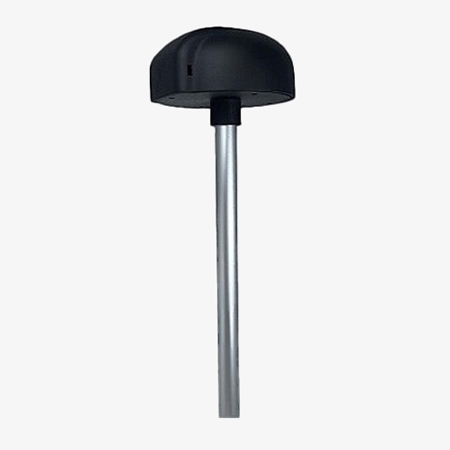
Core Sensing & Detection Functions
- This wireless capacitive level sensor comes with integrated millimeter wave radar that picks up human motion within 1-3 m, triggering an anti-theft alarm for fuel tank security.
- Built-in temperature sensor and tilt sensor deliver real-time data to support algorithm correction, securing reliable level reading under complex on-site conditions.
- Tank volume parameters can be quickly set up through mobile APP, simplifying on-site calibration for different fuel containers.
- Fully compatible with a wide range of non-conductive liquids including gasoline, diesel, and other similar media for fuel-level monitoring.
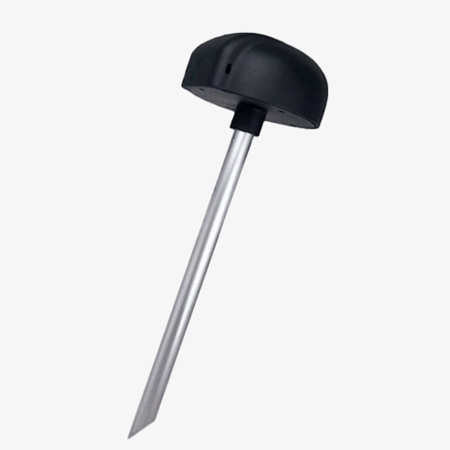
Communication & Power Performance
- Features Bluetooth BLE iBeacon broadcasting, enabling stable wireless signal broadcast for local data receiving and device discovery.
- Powered by an internal battery with ultra-low-power hardware design; this fuel level sensor can achieve up to 7-years of continuous operating time without frequent battery replacement.
Applications
This wireless capacitive level sensor is suitable for detecting the level of non-conductive liquids such as gasoline, diesel, and LPG. With flexible tank compatibility and reliable wireless measurement, this sensor is widely used in vehicle fuel tanks, industrial fuel storage containers, and LPG storage vessels for accurate fuel level management.

Garbage Truck

Refrigerated Truck

Dump Truck

Wrecker Truck
| Model | SISCO-CLS-CPM212 | |
| Accuracy | 99.50% | |
| Resolution | 0.1 mm | |
| Battery | Life | Maximum 6 years |
| Capacity | 2 × 2700 mAh, Li-SOCl₂ replicable industrial battery | |
| Working Temperature | -55 ~ 85℃ | |
| Bluetooth | Bluetooth Version | BLE 5.4 |
| Transmission Mode | iBeacon Broadcasting | |
| Broadcasting Interval | 1s as default, programmable | |
| Range of wireless connection (direct sight without interference and obstacles) | Maximum 100 meters | |
| Transmission power | -96 ~ 4 dBm | |
| Millimeter Wave Radar | Average Current | 50 uA |
| Working Temperature | -40 ~ 85℃ | |
| Transmission power (EIRP) | 10 dBm | |
| Detection Range | 0.2 ~ 5 meters | |
| Detection Resolution | 0.2 m | |
| Horizontal Detection Angle | 100 degrees | |
| Vertical Detection Angle | 120 degrees | |
| Tilt Angle Sensor | 0~180 degrees | |
| Temperature Sensor | -40~120 ℃ | |
| Working Environment | Working Temperature | -40℃~85℃ |
| Storage Temperature | -45℃~85℃ | |
| Capacitive Tube Range | 0~1000 mm (support cutting at site) | |
| Dimensions (mm) | 98 × 45 × (L),L: length of the measuring tube part, 10~100 cm | |
| Weight | 1 kg when L=70 cm | |
| Waterproof Class | IP69 | |
| Explosion-proof Class | Ⅱ 1 G Ex ia IIB T6 Ga | |
Structural Diagram
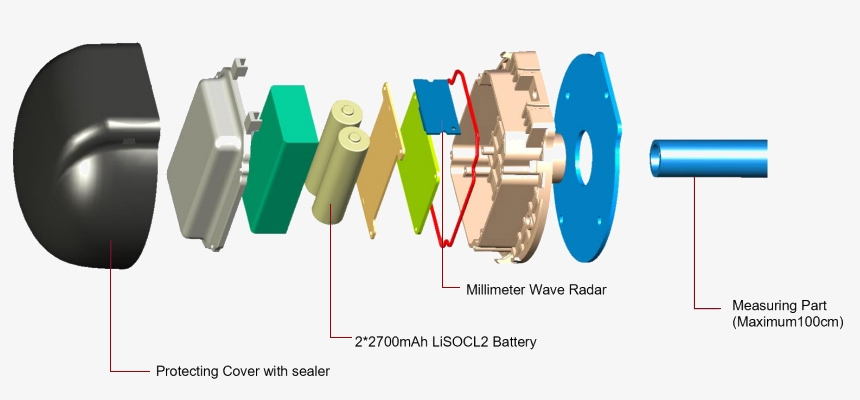

Q1: What is a wireless capacitive level sensor?
A1: A wireless capacitive level sensor is an electronic device that measures liquid levels using capacitive sensing technology and transmits measurement data wirelessly. It is designed for remote liquid-level monitoring without the need for traditional wiring, making installation easier for fuel tanks, storage containers, and industrial equipment.
Q2: How does a wireless capacitive level sensor work?
A2: A wireless capacitive level sensor detects changes in capacitance caused by variations in liquid level inside a tank. When the liquid height changes, the sensor measures the capacitance difference and converts it into a level signal, which is then transmitted wirelessly for remote monitoring.
Q3: Is a wireless capacitive level sensor suitable for mobile equipment?
A3: Yes. Wireless capacitive level sensors are suitable for mobile equipment such as trucks, construction machines, agricultural vehicles, and generators because they reduce wiring complexity and support remote monitoring.
Tips: What is the installation advantage of a wireless capacitive level transmitter?
The main installation advantage of a wireless capacitive level transmitter is that it reduces the need for complex wiring. Without long signal cables, the sensor can be installed more easily on fuel tanks, storage containers, and industrial equipment, especially in locations where cable routing is difficult. This wireless design helps save installation time, reduce maintenance work, and provide a more flexible solution for remote liquid-level monitoring.
Thank you for buying industrial test and measurement equipment on SISCO.com, all products sold by SISCO and the partner cover a 12 months warranty, effective from the date of receiving the products.
What is covered?
SISCO is responsible for providing free spare parts, and free technical support to assist the customer to repair the defective products until the problem is solved.
What is not covered?
- Product purchased from anyone other than a SISCO store or a SISCO authorized reseller.
- Expendable parts.
- Routine cleaning or normal cosmetic and mechanical wear.
- Damage from misuse, abuse or neglect.
- Damage from use of parts other than SISCO approved.
- Damage from use outside the product’s usage or storage parameters.
- Damage from use of parts not sold by SISCO.
- Damage from modification or incorporation into other products.
- Damage from repair or replacement of warranted parts by a service provider other than a SISCO authorized service provider.
- Damage caused by the application environment not meeting the product usage requirements and the failure to perform preventive maintenance.

Shop on sisco.com for all of your industrial test and measurement equipment & accessories including portable detectors, meters, testers, scales, etc.


