
Color surrounds us every moment of our lives and affects our emotions, behaviors and beliefs in large and small, conscious and unconscious ways. Color can set a mood, warn us of danger, give us critical information and even bring us joy. Despite the universal presence of color, describing it remains elusive, in part due to variations in color perception from person to person and in part due to a lack of descriptors for each of the millions of shades seen by the human eye.
In modern industries where color accuracy plays a critical role, choosing the right measurement instrument is essential. Two of the most commonly used devices are colorimeters and spectrophotometers. While both are designed for color analysis, they differ in working principles, accuracy levels, and application scenarios.
Understanding the differences between these two instruments will help you select the most suitable solution for your testing requirements and improve overall quality control.
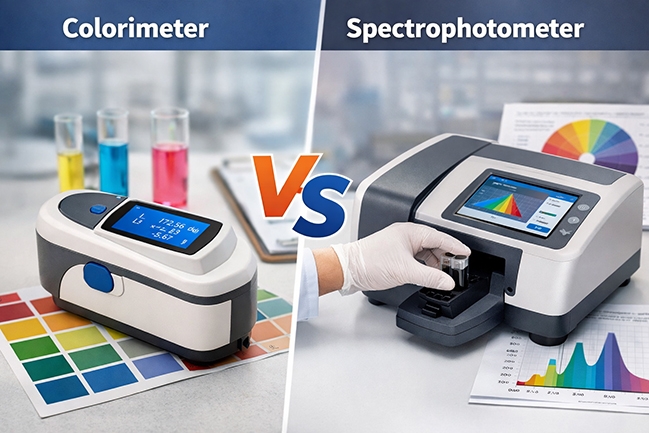
What Is a Colorimeter?
A colorimeter is an optical device used to measure the absorbance or reflectance of light in a sample. It typically relies on red, green, and blue (RGB) filters to simulate human vision and convert light signals into measurable color values such as LAB, XYZ, or RGB.
Colorimeters are widely used because they are simple, fast, and cost-effective. They are particularly suitable for routine measurements where extreme precision is not required but consistency and efficiency are important.
Many modern devices are designed as portable colorimeters, allowing users to perform on-site testing in various environments without the need for laboratory conditions.
Types of Colorimeters
Colorimeters are essential in determining color objectively and accurately. Their different varieties measure color to varying depths and degrees. Types include:
- Densitometers: These measure the darkness level, or density, of semi-transparent material.
- Photometers: Color photometers measure how color is transmitted and reflected.
Key Advantages of Colorimeters
- Fast measurement speed
- Easy operation with minimal training
- Cost-effective solution
- Portable for on-site testing
- Suitable for routine quality control
What Is a Spectrophotometer?
A spectrophotometer is a more advanced instrument that measures the full spectrum of light reflected or transmitted by a sample. Instead of using simple RGB filters, it analyzes light across multiple wavelengths, providing detailed spectral data.
This enables highly accurate and repeatable measurements, making spectrophotometers ideal for applications that require strict color consistency and precise color matching.
Spectrophotometers are commonly used in laboratories, research facilities, and industries where even slight color variations can impact product quality.
Key Advantages of Spectrophotometers
- High accuracy and repeatability
- Detailed spectral data analysis
- Better performance for complex colors
- Suitable for strict quality control environments
Types of Spectrophotometers
There are several types of spectrophotometers:
- Atomic absorption spectrophotometer: This analyzes the metal elements in materials by measuring the radiation absorption of atomic vapors.
- Fluorescence spectrophotometer: These spectrophotometers scan the fluorescence spectrum of liquid fluorescence labels and are typically used for scientific research, clinical tests, and food testing.
- Infrared spectrophotometer: This machine measures the absorbance levels of materials to a wavelength of less than 760 nm.
- UV-VIS spectrophotometer: Analyzing material as visible and ultraviolet wavelengths, this device quantitatively measures absorbance.
- VIS spectrophotometer: This device analyzes visible wavelengths, measuring absorbance and performing a quantitative analysis.
How Do They Work? (Technical Difference)
The fundamental difference between a colorimeter and a spectrophotometer lies in how each device processes and analyzes light. While both are designed to measure color, the depth and method of analysis are significantly different.
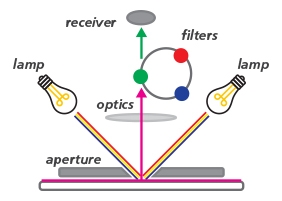
A colorimeter measures light intensity at a few selected wavelengths using red, green, and blue (RGB) filters. These filters approximate the sensitivity of the human eye, allowing the device to quickly convert light signals into color values such as RGB or CIE LAB. Because it only samples limited portions of the spectrum, the data it produces is sufficient for general color comparison and routine quality control. However, this simplified approach means it may struggle with highly saturated colors, subtle color differences, or materials with complex optical properties.
In contrast, a spectrophotometer analyzes light across the entire visible spectrum, typically ranging from 400 to 700 nanometers. Instead of relying on filters, it uses a monochromator or diffraction grating to break light into many narrow wavelength intervals. The instrument then measures the intensity at each wavelength and generates a detailed spectral curve (reflectance or absorbance curve). This curve provides a “fingerprint” of the sample’s color, enabling highly precise and repeatable measurements, even under varying lighting conditions.
Because of this full-spectrum analysis, spectrophotometers can detect very small color differences, perform advanced color matching, and support strict quality standards required in industries such as printing, coatings, and pharmaceuticals. However, this higher level of precision comes with increased complexity, larger size, and higher cost compared to colorimeters.
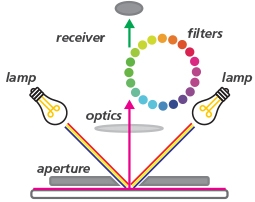
In summary, a colorimeter offers speed and simplicity by approximating human vision with limited wavelength data, while a spectrophotometer delivers superior accuracy and detailed analysis by measuring the complete light spectrum.
Differences Between Colorimeter and Spectrophotometer
| Feature | Colorimeter | Spectrophotometer |
|---|---|---|
| Measurement Principle | Uses RGB filters | Measures full light spectrum |
| Accuracy | Moderate | High |
| Data Output | Basic color values | Detailed spectral data |
| Cost | Lower | Higher |
| Ease of Use | Simple | More complex |
| Portability | Highly portable | Typically larger or advanced portable models |
Which One Should You Choose?
Choosing between a colorimeter and a spectrophotometer depends on your application:
- Choose a colorimeter if you need fast, portable, and cost-effective measurements for routine use.
- Choose a spectrophotometer if your work requires high precision, detailed analysis, and strict color consistency.
For most industrial applications, a colorimeter provides a good balance between performance and affordability. However, for laboratory-grade accuracy, a spectrophotometer is the better investment.
Conclusion
Both colorimeters and spectrophotometers play important roles in modern color measurement, each designed to meet different levels of accuracy and application requirements. Spectrophotometers provide advanced analytical capabilities with full-spectrum data, making them ideal for laboratory research and high-precision industries. In contrast, colorimeters are widely used for routine testing thanks to their simplicity, portability, and cost-effectiveness.
For businesses looking for reliable testing solutions, SISCO online store offers a wide range of colorimeters and spectrophotometers suitable for various industrial, environmental, and laboratory applications. Whether you need a portable device for field use or a high-precision instrument for detailed analysis, choosing the right equipment is essential for ensuring consistent and accurate results.
By understanding the differences between these two instruments, users can make informed decisions and select the most appropriate tool for their specific testing needs, ultimately improving efficiency and product quality.