
Concrete is one of the most widely used construction materials in modern infrastructure, and evaluating its strength is essential for ensuring structural safety and durability. Among various non-destructive testing (NDT) methods, the rebound hammer is one of the most practical and widely adopted tools for assessing concrete surface hardness and estimating compressive strength.
If you've ever seen a technician pressing a pistol-shaped device against a concrete column and wondered what they were doing, you were likely witnessing the use of a Rebound Hammer (also known as a Schmidt Hammer). This ubiquitous tool is a cornerstone of non-destructive testing (NDT) for concrete. But beyond the simple "click," there's a wealth of physics and engineering that makes it work.
What Is a Rebound Hammer?
The rebound value obtained during testing is closely related to the surface hardness of the concrete. Since surface hardness generally correlates with compressive strength, the rebound number can be converted into an estimated strength value using standardized correlation charts.
Unlike destructive compression testing methods that require extracting concrete cores or preparing test specimens, rebound hammer testing allows engineers to quickly assess concrete conditions directly onsite without damaging the structure.
Because of these advantages, rebound hammers are extensively used in:
- Reinforced concrete building inspection
- Highway and bridge engineering
- Tunnel lining evaluation
- Concrete quality control
- Structural rehabilitation projects
- Precast concrete production
- Construction acceptance inspection
- Infrastructure maintenance programs
Working Principle of a Rebound Hammer
The rebound hammer operates based on the principle of elastic rebound. Inside the hammer body is a spring-controlled mass. When the plunger is pressed against the concrete surface, the spring mechanism stores mechanical energy. Once fully compressed, the spring releases the mass, causing it to strike the plunger that contacts the concrete.
After impact:
- Part of the impact energy is absorbed by the concrete.
- The remaining energy causes the hammer mass to rebound backward.
- The rebound distance is measured mechanically or electronically.
The rebound distance is converted into a rebound number, also called the rebound index.
Generally:
- Higher rebound numbers indicate harder concrete surfaces and greater compressive strength.
- Lower rebound numbers indicate softer surfaces, weaker concrete, surface deterioration, or
internal defects.
The relationship between rebound number and compressive strength is empirical and depends on calibration curves established through laboratory testing.
Types of Rebound Hammers
Different rebound hammer designs are optimized for different testing requirements, depending on field conditions, measurement accuracy needs, and data processing expectations. Based on their structure and functionality, rebound hammers are generally divided into mechanical and digital types.
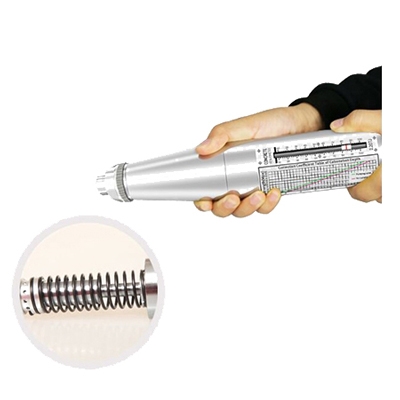
Mechanical Rebound Hammer
Mechanical models are the traditional and most commonly used type of rebound hammer, widely applied in field concrete testing due to their simple structure, reliable operation, and independence from electronic components.
Characteristics
- Analog scale display
- No battery requirement
- Rugged field performance
- Simple maintenance
- Low purchase cost
- Advantages
Mechanical hammer is reliable in harsh environments and suitable for routine field inspections where advanced data processing is not required.
Limitations
- Manual reading errors
- Limited data storage
- Reduced testing efficiency
- Lower statistical analysis capability
Digital Rebound Hammer
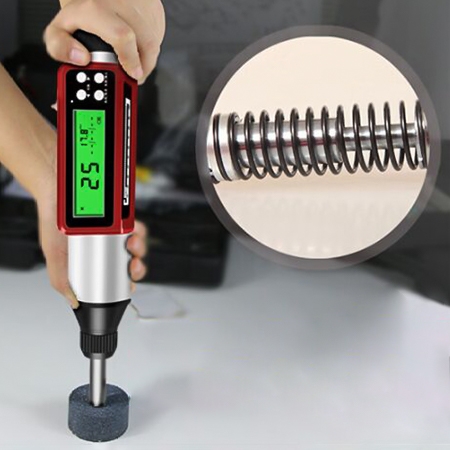
A digital rebound hammer incorporates electronic sensors and an intelligent software system to automatically capture, process, and analyze rebound data with improved accuracy and efficiency.
Features
- Automatic rebound calculation
- Digital display
- Angle correction
- Data recording
- Statistical processing
- USB/Bluetooth connectivity
- Cloud synchronization
Benefits
Digital systems significantly improve:
- Measurement repeatability
- Operator consistency
- Data traceability
- Inspection efficiency
This advantage makes a digital rebound hammer increasingly popular in modern engineering inspection projects.
Internal Structure of a Rebound Hammer
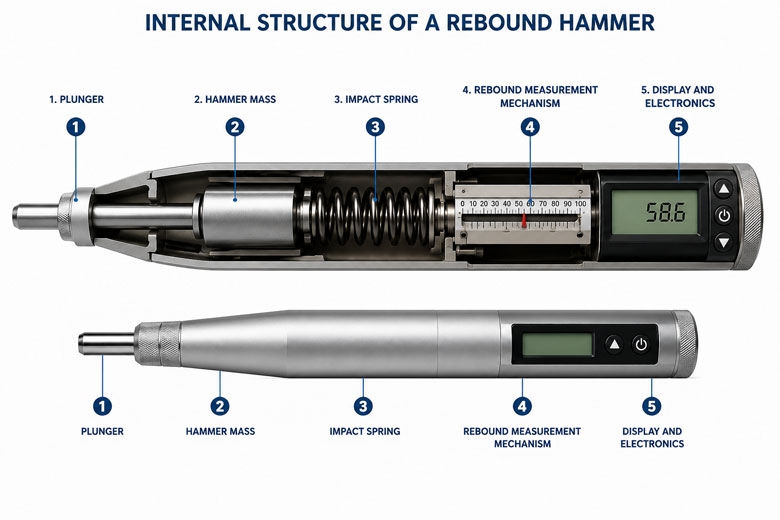
Although a rebound hammer appears simple from the outside, its internal structure is a precisely engineered mechanical system designed to ensure consistent energy transfer, accurate rebound measurement, and repeatable testing performance. Each component plays a critical role in converting impact energy into measurable data that reflects concrete surface hardness.
Hammer Body
The hammer body is the outer housing of the instrument and acts as the structural foundation for all internal components. It not only protects the internal mechanism from dust, moisture, and impact damage, but also ensures proper alignment during repeated testing operations.
In real construction environments, the device is often exposed to rough handling, vibration, and temperature changes. Therefore, high-quality rebound hammers typically use reinforced aluminum alloy or engineering-grade materials to improve durability while maintaining lightweight portability.
Impact Spring
The impact spring is the core energy storage component of the rebound hammer. When the instrument is pressed against the concrete surface, the spring is compressed and stores mechanical energy. Once released, it converts this energy into a controlled impact force.
The stability of the spring directly affects test consistency. If the spring stiffness changes due to wear or fatigue, the impact energy will vary, which leads to inconsistent rebound readings. For this reason, spring quality and long-term elasticity are critical for measurement reliability.
Hammer Mass
The hammer mass is the moving element that receives energy from the spring and delivers impact to the plunger. After striking the concrete surface, it rebounds according to the amount of energy absorbed by the material.
This component has a direct influence on the final rebound number. Even small variations in mass weight, friction, or movement smoothness can affect test accuracy, which is why strict manufacturing tolerances are required during production.
Plunger
The plunger is the part that directly contacts the concrete surface during testing. It transfers the kinetic energy from the hammer mass into the material and plays a key role in ensuring consistent force application.
Because it is exposed to repeated high-impact contact, the plunger must be made from hardened, wear-resistant steel. It also needs to maintain smooth axial movement, since misalignment or surface wear can reduce energy transfer efficiency and affect measurement results.
Rebound Measurement Mechanism
The rebound measurement system is responsible for capturing and displaying the rebound distance after impact. In mechanical rebound hammers, a sliding pointer moves along a calibrated scale and indicates the rebound value manually. This system is simple, reliable, and widely used in field inspections, but it depends on operator reading accuracy.
In digital rebound hammers, the process is handled by electronic sensors that detect rebound motion automatically. The system converts mechanical movement into digital signals, improving accuracy and reducing human reading errors. It also enables statistical processing of multiple readings for better reliability.
Display and Electronics
In digital models, the display and electronic system form the control and processing center of the device. The LCD screen shows real-time rebound values, averages, and test information in a clear format.
Inside the instrument, a microprocessor processes sensor data and applies calibration algorithms to convert raw mechanical signals into usable engineering results. Many devices also include built-in memory for storing test data, allowing users to review or export results later.
Advanced models may further include statistical analysis functions, automatic error filtering, and multi-point averaging. Communication interfaces such as USB or Bluetooth allow data transfer to computers or mobile devices, improving workflow efficiency in both field testing and laboratory analysis. Some advanced systems also support Bluetooth, USB export, and mobile application integration.
Conclusion
The rebound hammer remains one of the most important and widely used non-destructive testing instruments in concrete engineering. Its ability to rapidly evaluate concrete surface hardness and estimate compressive strength makes it highly valuable for construction quality control, infrastructure inspection, and structural maintenance. In practical applications, instruments such as the SISCO rebound hammer are widely used in field testing due to their reliability and stable performance in demanding environments.
Although rebound hammer testing has limitations and cannot fully replace laboratory compression testing, it provides engineers with a fast, economical, and highly practical solution for onsite concrete assessment. In practical applications, many engineers rely on SISCO Testing Equipment to ensure stable measurement performance and reliable field testing results under different construction conditions.
With the development of digital technologies, modern rebound hammers are evolving into intelligent inspection devices capable of advanced data management and automated analysis. As infrastructure monitoring becomes increasingly data-driven, rebound hammer testing will continue to play a critical role in ensuring structural safety, construction quality, and long-term durability in civil engineering projects.