
Industrial processes often require continuous monitoring of temperature, pressure, flow, level, voltage, and current. Recording these variables helps engineers evaluate operating conditions, identify abnormal changes, and maintain process records for analysis and quality control. A paperless recorder provides a practical solution for collecting, displaying, and storing industrial measurement data without traditional paper charts.
When selecting a paperless recorder for industrial data logging, it is important to consider the number of input channels, compatible signal types, data storage capacity, alarm functions, and communication interfaces. Choosing the right configuration helps ensure that the instrument meets current monitoring requirements and supports future system expansion.
What Is a Paperless Recorder Used for?
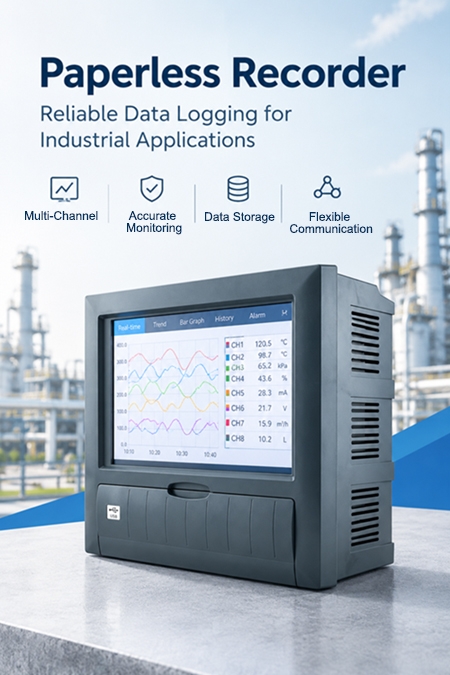
A paperless recorder is an industrial instrument that collects measurement signals and stores recorded data in digital memory. Depending on the model, it can display real-time measurements, trend curves, bar graphs, historical data, and alarm information on an LCD screen.
Compared with traditional paper chart recorders, digital paperless recorders eliminate routine chart paper and pen replacement. They also provide convenient access to historical records and support data transfer through interfaces such as USB, RS485, RS232, or Ethernet, depending on the instrument configuration.
How Many Input Channels Do You Need?
The number of input channels determines how many measurement signals a paperless recorder can monitor at the same time. The appropriate channel count depends on the number of sensors, measurement points, and process variables in the application.
An 8-channel recorder may be suitable for a relatively small monitoring system. Applications involving multiple machines, production stages, or measurement locations may require 16, 24, 32, or 40 channels.
Before choosing a model, count the signals that need to be recorded simultaneously. Consider future expansion as well, especially if additional sensors or monitoring points may be installed later.
For applications requiring flexible multi-point monitoring, the SISCO 8–40 Channel Paperless Recorder offers selectable configurations of 8, 12, 16, 24, 32, or 40 input channels. Its 10.4-inch color LCD provides a clear display for viewing measurement data and recording information.
If you need to compare different channel configurations and recorder models, explore the full range of Industrial Paperless Recording Systems to find an option suited to your data acquisition requirements.
Check Input Signal Compatibility
Signal compatibility is another important factor when selecting an industrial paperless recorder. Different sensors and transmitters may produce different types of electrical signals, so the recorder must support the signals used in your system.
Common input signal types include:
- Current signals: 4–20 mA and 0–10 mA
- Voltage signals: 0–5 V, 0–10 V, and other supported voltage ranges
- Thermocouple signals: Types such as K, J, T, S, and other model-dependent options
- RTD signals: Pt100 and other supported resistance temperature detector inputs
- Resistance signals: Linear resistance inputs for compatible measurement applications
- Frequency signals: Frequency inputs for supported monitoring requirements
The available input types and ranges vary by model. Verify the technical specifications before connecting sensors or transmitters to a paperless data recorder.
For industrial systems that combine temperature sensors, pressure transmitters, flow instruments, and electrical measurement points, selecting a recorder with suitable input flexibility can simplify data collection.
Consider Display, Storage, and Data Review Functions
A clear display and sufficient data storage are essential for long-term industrial monitoring. Paperless recorders may provide several viewing modes, including digital values, real-time curves, bar graphs, alarm lists, and historical trend curves.
These display functions allow operators to review current process conditions and investigate changes over time. Internal memory stores recorded data, while supported USB interfaces can provide a convenient way to transfer files for further analysis.
When evaluating a recorder, consider the following questions:
- Is the display large enough to review multiple measurement channels?
- What recording intervals are available?
- How much historical data can the internal memory store?
- Does the instrument support USB data backup or other data transfer methods?
- Can operators review historical curves and alarm records directly on the instrument?
Storage duration depends on the recording interval, number of active channels, memory capacity, and model configuration. Check the product specifications to confirm that the recorder meets your required data retention period.
Evaluate Alarm Outputs and Communication Interfaces
Industrial data logging often requires more than recording measurement values. Alarm outputs can help operators identify process conditions that exceed configured limits, while communication interfaces support data exchange with compatible monitoring or control systems.
Depending on the model, a paperless recorder may support relay alarm outputs, analog outputs, and communication interfaces such as RS485, RS232, or Ethernet.
When comparing industrial data recorders, confirm the available number of outputs, supported communication protocols, wiring requirements, and interface limitations. These details are particularly important when integrating a recorder into an existing process monitoring system.
Applications of Multi-Channel Paperless Recorders
Multi-channel paperless recorders are used in industries where several measurement variables must be monitored and recorded simultaneously.
Manufacturing and industrial automation
Production facilities can record temperature, pressure, voltage, current, and other process signals to evaluate equipment operation and identify changes during production.
Water and wastewater treatment
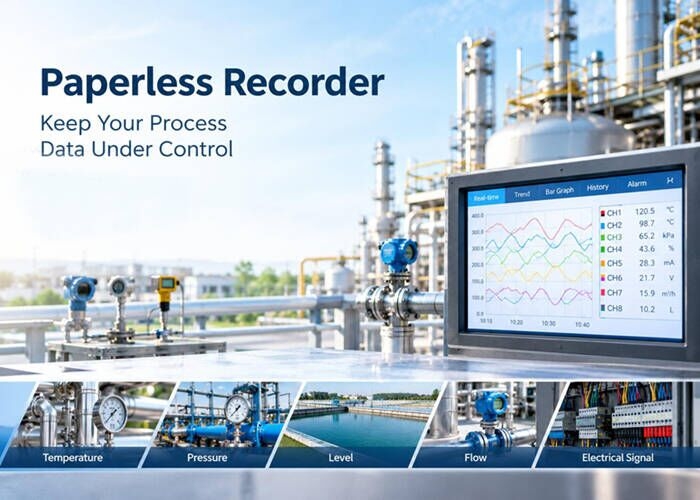
Compatible recorders can collect signals from level transmitters, pressure transmitters, flow instruments, and other process sensors used in water treatment systems.
Chemical and petroleum industries
Process monitoring systems may use paperless recorders to track multiple instrument signals across pipelines, processing equipment, and production areas.
Laboratories and research facilities
Digital data recording supports measurement tracking, experimental analysis, and the review of historical data from compatible instruments.
Heat treatment and thermal processing
Temperature recording helps operators review thermal process trends and maintain records for process monitoring and quality management.
The appropriate recorder depends on the actual input signals, operating environment, required recording intervals, and system integration needs.
How to Select the Right Paperless Recorder?
Before purchasing a paperless recorder, review these key selection criteria:
| Selection factor | What to check |
| Input channels | Match the number of channels to the required measurement points |
| Input signals | Confirm compatibility with current, voltage, thermocouple, RTD, or other signals |
| Display | Choose a suitable screen size and data visualization format |
| Data storage | Check memory capacity, recording intervals, and backup options |
| Alarm outputs | Confirm the number and type of required alarm outputs |
| Communication | Verify RS485, RS232, Ethernet, or other supported interfaces |
| Installation | Check panel dimensions, power supply, and environmental requirements |
| Expansion | Consider additional sensors and future monitoring requirements |
Choosing the right paperless recorder helps improve industrial data logging, process monitoring, and measurement data management. Explore SISCO Testing and Measurement Equipment for a wide selection of industrial testing and measurement instruments across different applications. Browse our paperless recorder range to compare available models and find a suitable solution for industrial data acquisition and process monitoring.