
In the vast landscape of industrial machinery, few pieces of equipment are as versatile and essential as the ball mill. For centuries, this robust grinding device has played a pivotal role in transforming raw materials into finely processed powders, serving as a cornerstone in industries ranging from mining and cement production to pharmaceuticals and nanotechnology. Unlike traditional milling machines that rely on rotary cutters to reshape workpieces, the ball mill operates on a simpler yet profoundly effective principle: using grinding media to crush, grind, and blend materials through impact and attrition. This article delves into the ball mills, exploring working principles, types, applications, and the advantages & limitations.
What is a Ball Mill?
A ball mill is a type of grinding machine used to reduce materials into fine powder. It consists of a rotating cylindrical shell filled with grinding media, usually steel or ceramic balls. As the cylinder rotates, the balls fall back and forth, crushing and grinding the material inside through impact and friction.
What is the Working Principle of a Ball Mill?
A ball mill operates on the principle of impact, shear, and abrasion forces generated by moving grinding media. The core structure includes a rotating jar filled with media (such as a stainless steel ball) and sample material. As the jar rotates, centrifugal force lifts the media to a certain height, after which gravity causes them to cascade or tumble down. This cyclic motion creates three key grinding actions: high-impact force from falling media shatters large particles, shear force between colliding media breaks down agglomerates, and abrasion from continuous friction refines particle size.
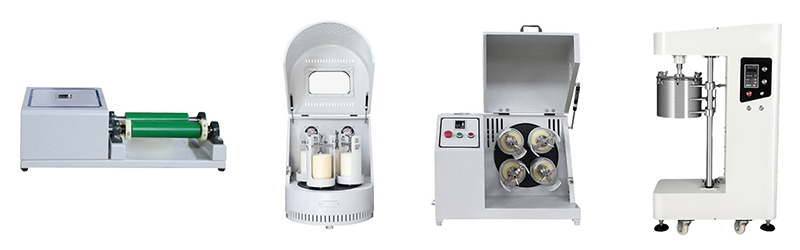
Different Types of Ball Mills:
Ball mill machines come in a variety of designs, each tailored to specific applications and processing requirements. The most common types include:
- Horizontal Ball Mill. A horizontal ball mill is a type of grinding equipment used to reduce materials into fine powder. It consists of a rotating cylindrical drum positioned horizontally and partially filled with grinding media such as steel balls. As the cylinder rotates, the balls cascade and impact the material, breaking it down through impact and abrasion. Horizontal ball mills are widely used in industries like mining, cement, and chemical processing due to their high efficiency and ability to handle large volumes of material. They are especially suitable for continuous operation and uniform particle size distribution.
- Vertical Ball Mill. A vertical ball mill is a type of grinding machine where the grinding media (balls) and material are contained in a vertically oriented chamber. Unlike horizontal mills, it uses gravity to assist in the grinding process. Material is fed from the top and moves downward as it is crushed and ground between rotating balls and the mill walls.
- Planetary Ball Mill. Planetary ball mill is a high-energy mill used for ultra-fine grinding and material synthesis. It consists of several grinding jars that rotate around a central axis while simultaneously spinning on its own axes. This dual rotation creates a high centrifugal force, resulting in intense grinding. Planetary ball mill is commonly used in laboratories and research facilities for producing nanoparticles, alloys, and advanced materials. We offer both horizontal planetary ball mill and vertical planetary ball mill on our website.
- Roller Ball Mill. A roller ball mill is a grinding machine that combines the principles of a ball mill and a roller press to reduce materials into fine powder. It uses rotating cylindrical chambers filled with grinding media (steel or ceramic balls) along with rollers that apply additional pressure. As the chamber rotates, the balls impact and grind the material, while the rollers enhance crushing efficiency. This hybrid design improves energy efficiency, reduces grinding time, and produces more uniform particle sizes. Roller ball mills are widely used in industries such as cement, mining, and chemical processing for grinding ores, clinker, and other bulk materials.
- Stirred Ball Mill. A stirred ball mill is a type of grinding machine used for fine and ultrafine size reduction of materials. Unlike traditional tumbling mills, it uses a stationary shell filled with small grinding media that are agitated by a rotating stirrer or shaft. This intense agitation creates high shear and impact forces, efficiently breaking down particles to micron or even nanometer sizes.
Advantages and Limitations of Ball Mill:
Like any piece of equipment, ball mill mixers have both advantages and limitations that must be considered when selecting the right grinding solution.
Advantages:
- Versatility. Ball mills can handle a wide range of materials, from soft to hard, and can produce particles of varying sizes, from coarse to ultra-fine.
- Cost-effectiveness. Ball mills are relatively inexpensive to purchase and operate compared to other grinding technologies. They also have a long service life with proper maintenance.
- Uniform Grinding. The combination of impact and attrition ensures that materials are ground uniformly, resulting in a consistent product quality.
- Energy Efficiency. Modern ball mills are designed to be energy-efficient, with features like advanced control systems that optimize grinding performance while reducing energy consumption.
Limitations:
- Contamination Risk. Steel grinding media can introduce metal contamination into sensitive products, making them unsuitable for applications like food processing or pharmaceutical manufacturing.
- Noise and Vibration. Ball mills can generate significant noise and vibration during operation, which may require additional insulation or vibration-dampening measures.
- Heat Generation. Friction between the grinding media and material can generate heat, which may affect the quality of heat-sensitive materials. Cooling systems may be necessary to maintain optimal operating temperatures.
- Maintenance Requirements. Ball mill machines require regular maintenance, including replacing worn liners and grinding media, lubricating bearings, and inspecting gear systems. This can result in downtime and additional costs.
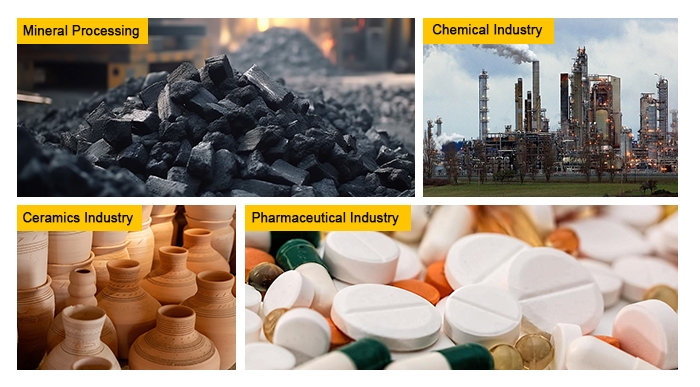
Application Fields of Ball Mill:
1. Mining and Mineral Processing
Ball mills are extensively used in the mining industry to grind ores such as gold, copper, iron, and zinc. They help liberate valuable minerals from surrounding rock, improving extraction efficiency. Both wet and dry grinding processes are commonly applied in this field.
2. Cement Industry
In cement production, ball mill machines are used to grind raw materials like limestone and clay, as well as clinker after the kiln process. They ensure uniform particle size, which is crucial for producing high-quality cement with consistent strength and performance.
3. Chemical Industry
Ball mills are used to grind and mix chemicals, pigments, fertilizers, and other materials. Their ability to achieve fine and uniform particle sizes makes them ideal for producing paints, coatings, and chemical compounds.
4. Pharmaceutical Industry
In pharmaceuticals, ball mill machines are used for size reduction and mixing of active ingredients and excipients. Fine particle size improves drug absorption and ensures consistent dosage in tablets and capsules.
5. Ceramics and Glass Industry
Ball mill mixers are essential for grinding raw materials such as feldspar, quartz, and clay in ceramic production. They help achieve the fine texture required for high-quality ceramics and glass products.
6. Environmental and Recycling Applications
Ball mills are increasingly used to process waste materials, including electronic waste and industrial by-products. They help in recycling valuable materials and reducing environmental impact.
Conclusion:
In conclusion, a ball mill remains one of the most essential and versatile pieces of equipment in modern industrial processing. Its simple structure, reliable performance, and adaptability make it a preferred choice across industries such as mining, cement production, and chemical engineering. By using grinding media to break down materials into finer particles, a ball mill machine ensures efficiency and consistency in size reduction, which is critical for downstream processes.
Moreover, advancements in technology have further improved the energy efficiency and automation of ball mills, making them more sustainable and cost-effective. As industries continue to demand higher productivity and precision, the role of ball mills is expected to evolve alongside innovative engineering solutions. Whether used for large-scale industrial production or specialized laboratory applications, understanding some information of a ball mill helps users maximize its potential and achieve better results. If you want to know more, SISCO Online Shop will do our best to provide assistance.