
Air quality monitoring for homes is the process of measuring and tracking indoor environmental conditions and common air pollutants. Depending on the device, a home air quality monitor may measure particulate matter such as PM1.0, PM2.5, and PM10, as well as carbon dioxide (CO2), total volatile organic compounds (TVOC), formaldehyde (HCHO), temperature, and humidity.
Indoor air quality can change throughout the day. Cooking, cleaning, using household products, outdoor pollution, poor ventilation, combustion appliances, and excessive moisture can all affect indoor air conditions.
For homeowners, the purpose of an air quality monitor is not simply to display numbers. It provides measurable information that can help identify changes in indoor air conditions and determine when ventilation, source control, moisture management, or air cleaning may be appropriate.
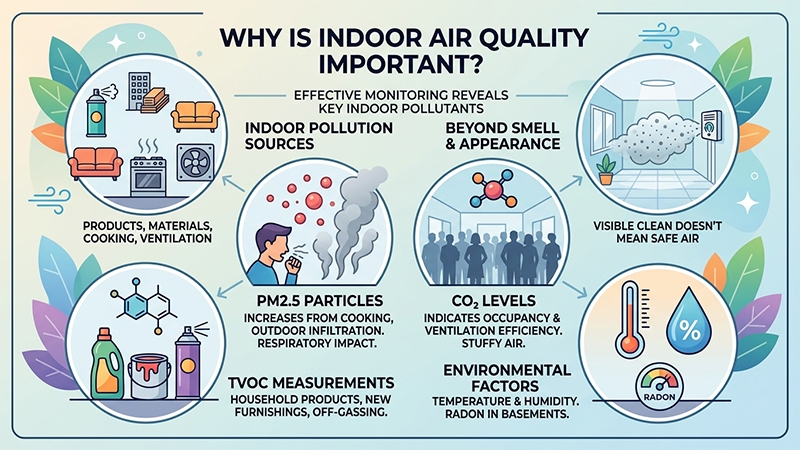
Why is Indoor Air Quality Important?
Indoor air is affected by both indoor and outdoor sources. Inadequate ventilation can allow indoor pollutant levels to increase because pollutants are not sufficiently diluted or removed. Household products, building materials, furnishings, cooking, tobacco smoke, and combustion appliances can all contribute to indoor pollution.
This is why indoor air should not be judged only by smell or appearance. Some pollutants are difficult to detect with human senses. A room can look clean while still experiencing changes in particulate matter, CO2, VOCs, or humidity.
Air quality monitoring provides another layer of information: measured data.
For example:
- A PM2.5 increase may occur during cooking or when outdoor particles enter the home.
- CO2 levels can provide useful information about occupancy and ventilation conditions.
- TVOC measurements can help users observe changes associated with household products and other VOC sources.
- Temperature and humidity measurements provide additional information about the indoor environment.
- Radon monitors can be used when radon monitoring is specifically required, particularly in areas such as basements.
What Should a Home Air Quality Monitor Measure?
There is no single sensor combination that is suitable for every home. The right air quality monitor depends on the pollutants or environmental conditions you want to observe.
1. PM1.0, PM2.5 and PM10
Particulate matter refers to airborne particles of different sizes. PM2.5 is particularly important in indoor air monitoring because fine particles can be generated by activities such as cooking, combustion, and smoke. A monitor capable of displaying PM1.0, PM2.5, and PM10 can provide a broader view of particulate conditions.
2. CO2
CO2 monitoring is useful for observing indoor ventilation conditions. When many people occupy a relatively enclosed room, CO2 levels can rise. CO2monitor can therefore be useful in bedrooms, living rooms, home offices, classrooms, and other occupied indoor spaces.
3. TVOC and HCHO
VOCs can come from paints, cleaning products, air fresheners, building materials, furnishings, and other household products. Formaldehyde is one specific compound that may be monitored separately from TVOC.
4. Temperature and Humidity
Temperature and humidity affect indoor comfort and can also provide useful context for interpreting other environmental measurements. Controlling moisture and keeping indoor relative humidity below 60%, with 30–50% described as an ideal range in the home.
How to Use an Air Quality Tester at Home?
For meaningful results, placement and measurement habits matter.
- Step 1: Choose a representative location. Place the tester in the room you want to understand. Avoid placing it directly beside an open window, air outlet, cooking appliance, or strong pollution source unless you specifically want to measure that location.
- Step 2: Establish a baseline. Monitor the room during normal daily activities. Record or observe the typical readings at different times.
- Step 3: Compare before and after activities. Check readings before and after cooking, cleaning, opening windows, running ventilation equipment, or using an air purifier. Changes in measurements can help identify relationships between activities and indoor conditions.
- Step 4: Look for trends rather than one isolated number. Indoor air quality changes over time. A repeated pattern can provide more useful information than a single reading.
- Step 5: Take action based on the source. If measurements indicate a change in air conditions, consider practical measures such as source control, improved ventilation, moisture control, or appropriate filtration.
SISCO Air Quality Monitors for Home Monitoring
For users looking for practical indoor air measurement tools, SISCO Online Shop offers a range of air quality monitors designed for different monitoring needs.
The SISCO air quality monitors range includes models for measuring different combinations of particulate matter, gases, and environmental parameters. Depending on the model, users can monitor PM1.0, PM2.5, PM10, CO2, TVOC, HCHO, AQI, temperature, and humidity.
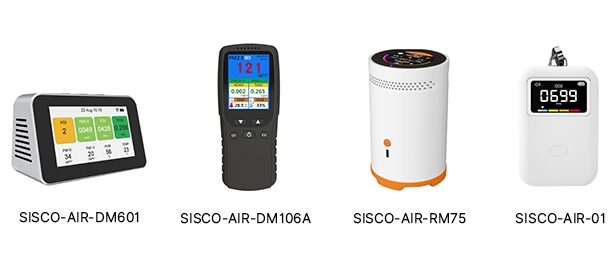
For example, the SISCO-AIR-DM601 combines PM1.0, PM2.5, PM10, CO2, TVOC, temperature, and humidity monitoring, with AQI information, and supports 24-hour real-time monitoring. The SISCO-AIR-DM106A is a handheld model that measures PM1.0, PM2.5, PM10, AQI, HCHO, TVOC, temperature, and humidity.
For homes where radon monitoring is a specific requirement, SISCO also offers dedicated radon monitors. The SISCO-AIR-RM75 is designed for real-time radon monitoring and climate data in indoor environments such as basements and living spaces.
The product range also includes small and portable options for users who need simple CO2 monitoring. The SISCO-AIR-01 measures CO2 from 400 to 5000 ppm and is designed for indoor environments such as homes, offices, and schools.
How Can I Improve Air Quality After Monitoring?
An air quality meter is a measurement tool, not a substitute for ventilation equipment, filtration systems, smoke alarms, or carbon monoxide alarms.
If indoor measurements change significantly, first consider the possible source. For example, cooking may increase particle levels, while cleaning products or newly installed materials may contribute to VOCs. Poor ventilation may also allow pollutants to accumulate.
Common approaches include:
- Control pollution at the source.
- Improve ventilation when appropriate.
- Control indoor moisture.
- Use suitable air filtration or cleaning equipment.
- Maintain combustion appliances and ensure proper venting.
- Use dedicated alarms and detectors where required.
Monitoring is most useful when it is combined with an understanding of the source and an appropriate response.
Frequently Asked Questions About Home Air Quality Monitoring
Q1: What is the purpose of a home air quality monitor?
A home air quality monitor measures selected indoor air parameters and helps users observe changes over time.
Q2: Can one monitor measure every indoor pollutant?
No. Different monitors use different sensors and measure different parameters. Choose a device according to the pollutants and environmental conditions you need to monitor.
Q3: Should I monitor PM2.5 at home?
PM2.5 monitoring can provide useful information about changes in fine particulate matter, particularly around activities such as cooking or combustion.
Q4: Where should I place an air quality detector?
Place it in a representative indoor location, away from direct airflow or localized sources unless you specifically want to measure that location.
Conclusion:
Air quality monitoring for homes provides a practical way to turn invisible indoor environmental changes into measurable data. By monitoring parameters such as PM2.5, PM10, CO2, TVOC, HCHO, temperature, humidity, or radon according to the application, homeowners can better understand how daily activities and ventilation affect indoor conditions.
The key is to select a monitor based on the parameters you actually need, place it correctly, observe trends over time, and combine the measurements with appropriate source control and ventilation practices.
For different home, office, car, and indoor monitoring requirements, or if you have other questions, please contact us, we'll do our best to support you.