
The microscope has long been one of the most important tools in science, education, industry, and research. Traditional optical microscopes have been used for centuries to magnify small objects, allowing humans to explore the microscopic world that is invisible to the naked eye. However, with the rapid development of digital technology, the digital microscope has emerged as a modern and highly advanced alternative. Compared with traditional microscopes, electron microscopes offer many new advantages in terms of usability, functionality, image quality, data storage, and accessibility.
A digital inspection microscope integrates optical magnification with digital imaging technology, typically using a camera sensor instead of—or in addition to—an eyepiece. The captured images can be displayed on a computer, tablet, or built-in screen in real time. This innovation has transformed the way people observe, analyze, and share microscopic images. From classrooms to laboratories, from manufacturing floors to medical facilities, digital microscopes are becoming increasingly popular.
In this article, we will explore in detail the key advantages of digital microscopes. By the end of this discussion, it will be clear why digital microscopes are considered a powerful and versatile tool in the modern world.
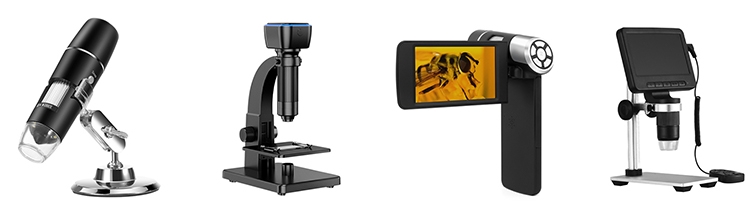
Digital Microscope Advantages:
1. Superior Image Quality and Clarity
One of the most significant advantages of an electronics inspection microscope is its ability to produce high-quality images. Unlike traditional microscopes that rely solely on optical lenses and human vision through an eyepiece, digital microscopes use advanced camera sensors to capture detailed images. These images are then processed and displayed on a digital screen, often with enhanced brightness, contrast, and resolution.
Many digital microscopes support high-definition imaging, sometimes up to 4K resolution. This allows users to see fine details more clearly than with conventional microscopes. Additionally, digital microscopes often come with built-in LED lighting systems that provide consistent and adjustable illumination. This reduces shadows and improves visibility, making it easier to observe specimens accurately.
Furthermore, electronics inspection microscopes often include software that allows users to adjust image settings such as brightness, contrast, color balance, and sharpness. This level of control helps researchers, students, and technicians obtain clearer and more accurate visual data, which is particularly useful in scientific analysis and quality inspection.
2. Easier and More Comfortable Observation
Traditional microscopes require users to look through a small eyepiece for extended periods, which can cause eye strain, neck pain, and discomfort. This is especially problematic in educational settings, where students may need to observe specimens for long durations.
Electronics inspection microscopes eliminate this issue by displaying images on a large screen instead of requiring direct eye contact with an eyepiece. Users can comfortably sit upright and view the specimen on a computer monitor, tablet, or integrated LCD display. This makes digital microscopes much more ergonomic and user-friendly, reducing physical fatigue and making microscopic observation more enjoyable.
Additionally, digital microscopes are easier to use for beginners. Instead of needing to adjust focus through a tiny knob while peering through an eyepiece, users can simply look at the screen and make adjustments accordingly. This intuitive design makes digital inspection microscopes particularly suitable for students, hobbyists, and professionals who may not have extensive microscopy experience.
3. Real-Time Viewing and Sharing
Another major advantage of digital microscopes is the ability to view images in real time on a screen. This is especially beneficial in classrooms, laboratories, and collaborative environments. Instead of only one person being able to observe through the eyepiece, multiple people can simultaneously view the same image on a shared screen.
This feature greatly enhances teaching and learning experiences. In a classroom, a teacher can display a microscopic image to all students at once, making explanations clearer and more interactive. In research or industrial settings, team members can analyze samples together without needing to take turns looking through a traditional microscope. Moreover, electron microscopes often support wireless or network connectivity, allowing images to be shared instantly via cloud storage, or specialized software platforms. Our website offers wifi digital microscope and usb & wifi digital microscope.
4. Image and Video Recording Capabilities
Unlike traditional microscopes, which only allow live observation, digital microscopes enable users to capture still images and record videos of their observations. This is one of the most powerful advantages of digital microscopy.
With a digital inspection microscope, users can easily save high-resolution images for documentation, analysis, or presentation. This is extremely useful in scientific research, medical diagnostics, and quality control. Instead of relying on hand-drawn sketches or written descriptions, users can store precise visual records of their findings.
Video recording is another valuable feature, particularly in dynamic studies such as observing live microorganisms, chemical reactions, or material behavior under stress. Researchers can record time-lapse videos or real-time footage, allowing them to analyze changes over time in greater detail.
5. Portability and Flexibility
Many electronics inspection microscopes are compact, lightweight, and portable. Such as handheld digital microscope, making them easy to carry and use in various locations. This is a major advantage for field researchers, technicians, and hobbyists who need to conduct observations outside of a traditional laboratory setting.
For example, environmental scientists can use portable digital microscopes to analyze water samples in the field. Industrial inspectors can bring digital inspection microscopes directly to production lines for on-site quality checks. Even artists and collectors can use digital microscopes to examine fine details in paintings, coins, or jewelry. This flexibility makes electron microscopes more versatile than traditional bulky laboratory microscopes.
Application Fields of the Electron Microscope:
Digital microscopes have become essential tools across many industries due to their high-resolution imaging, real-time display, and ease of documentation. Compared with traditional optical microscopes, they offer greater flexibility, efficiency, and accessibility. Their applications cover scientific research, industrial inspection, education, medical analysis, and everyday use.
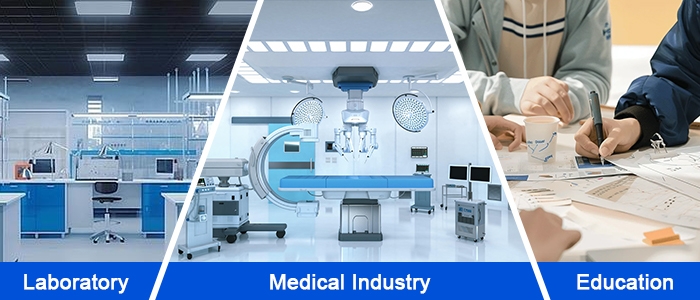
- Scientific Research and Laboratory. Digital microscopes are widely used in biology, chemistry, and material science. Researchers can observe microorganisms, cells, tissues, and chemical structures with enhanced clarity. The ability to capture images and videos supports data analysis, comparison, and reporting. This makes digital inspection microscopes valuable for experiments, publications, and collaborative studies.
- Industrial Inspection and Quality Control. In manufacturing, digital microscopes play a crucial role in product inspection. They are used to examine circuit boards, electronic components, solder joints, and microchips. Engineers can detect defects such as cracks, misalignments, or surface imperfections. This improves product reliability and reduces production errors.
- Medical and Clinical Applications. In medical fields, digital microscopes assist in pathology, dermatology, and hematology. Doctors and technicians use them to analyze blood samples, tissue sections, and skin conditions. Digital imaging allows for better diagnosis, and medical record keeping.
- Education and Teaching. Electron microscopes are increasingly used in schools and universities. They enable students to view specimens on a computer or screen instead of looking through an eyepiece. This enhances engagement, simplifies group learning, and allows teachers to demonstrate observations in real time.
Conclusion:
In conclusion, the advantages of a digital inspection microscope extend far beyond simple image magnification, representing a meaningful shift in how we observe, analyze, and share microscopic information. By combining high-resolution imaging, real-time display, and digital connectivity, digital microscopes make microscopic exploration more accessible, efficient, and versatile than ever before. They eliminate many of the limitations associated with traditional optical microscopes, such as eye strain, limited field of view, and difficulties in documentation. Instead, users can easily capture images and videos, store data. This not only enhances learning in educational settings but also improves precision and productivity in research, industrial inspection, and quality control. A variety of digital microscopes is available on SISCO.com. Should you have any further inquiries, please do not hesitate to contact us. Ultimately, the electron microscope is not just a tool but a bridge between the microscopic world and the digital age, empowering scientists, professionals, and enthusiasts alike to explore, understand, and innovate with greater clarity and confidence.